Key takeaways
- Knowledge gap analysis compares the recurring issues driving your support volume against your existing knowledge base to find what's undocumented and worth documenting.
- AI that drafts without a target produces content nobody uses.
- Cluster recurring cases, compare against your knowledge base, skip the one-offs, and prioritize by case volume times cost per case.
- Best practice is for humans approve every draft.
Most knowledge tools automate writing. The harder problem, and the one that actually limits support teams, is knowing what to write in the first place. There are thousands of recurring issues you could potentially write about. Knowledge gap analysis is how you decide which issues deserve an article using evidence instead of guesswork.
What is knowledge gap analysis?
Quick answer: Knowledge gap analysis is the process of identifying where support demand exists but documentation doesn't. It works by comparing recurring support issues (drawn from resolved cases) against your existing knowledge base, then surfacing the topics that generate repeat contacts and have no article behind them.
It's different from a general content audit, which reviews what you already have for accuracy and freshness. Gap analysis starts from demand, the questions customers and agents keep asking, and works backward to what's missing. As knowledge management practitioners note, the highest-value audits prioritize gaps by their impact on performance rather than trying to document everything at once.
Writing was never the bottleneck
Generative AI made drafting nearly free. A model can produce a plausible knowledge article in seconds. That's exactly why the constraint moved. When writing is cheap, the scarce resource is knowing what's worth writing.
Skip that step, and you get the failure mode every team now fears, articles nobody reads, generated at volume, cluttering the knowledge base and diluting retrieval. The point of gap analysis is to aim the drafting at real, recurring, undocumented demand, so every article earns its place.
How Mosaic AI helps: Choosing what to document is the expensive part, and it's the part Mosaic automates. Mosaic Knowledge runs this gap analysis continuously across your resolved cases, so drafting is always aimed at issues that are real, recurring, and undocumented, instead of adding to the pile of articles nobody reads.
How does knowledge gap analysis work?
The method involves 4 steps and is really quitesimple.It uses the same logic a thoughtful knowledge manager would apply by hand, run continuously across every case.
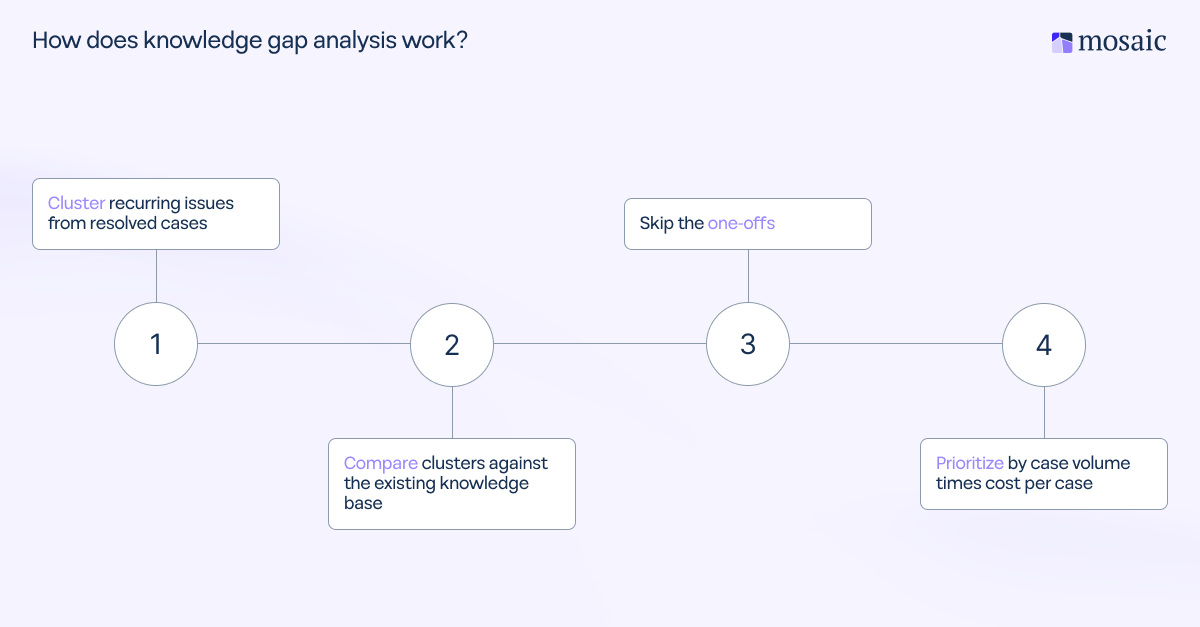
1. Cluster recurring issues from resolved cases
Start with what actually happened. Sample resolved cases and group them into recurring topics, so you're looking at patterns rather than individual tickets.
2. Compare clusters against the existing knowledge base
For each recurring topic, check whether documentation already covers it. The gaps are the topics generating repeat volume with no article behind them.
3. Skip the one-offs
Not every question deserves an article. A one-time issue from an external outage isn't worth documenting, and flooding the system with edge cases hurts retrieval accuracy.
"One-off questions could come back and confuse your AI with millions of irrelevant details." —Alon Talmor, CEO & Founder, Mosaic AI
4. Prioritize by case volume times cost per case
The remaining gaps still need ranking. Multiply how often a topic recurs by what each case costs to close, and the priority order writes itself.
"100 cases of a specific topic times your cost-per-case closed = your the value opportunity." —Ben Nachmani, Head of Partnerships, Mosaic AI
Why humans need to stay in the loop
Automating the analysis doesn't mean automating the judgment. The point of drafting a first version is to save time, not to remove the person who knows whether it's right.
"The human in the loop process is fundamentally necessary." —Ben Nachmani, Head of Partnerships, Mosaic AI
Avoids arbitrary edit limits
A common question from teams adopting this: Is there a limit on how much I should edit an AI draft? The answer is no.
The draft is a starting point, and the case evidence behind it, and the human's job is to review the cases, confirm the article makes sense, and decide where it belongs, whether that's external self-service, internal-only, or not worth publishing at all. There's no quota on judgment.
Ensures articles are built for retrieval
Human reviewers also keep articles in the shape AI retrieval needs: Short, specific, single-purpose. For multi-product teams that means the same procedure documented separately per product line, which feels redundant but is exactly what makes answers accurate when the system assembles them.
What a prioritized gap map looks like
The output of gap analysis isn't a pile of drafts. It's a prioritized map: recurring topics, ranked by volume and cost, organized into collections by product line, issue type, or any attribute that matters to your team. For a leader supporting a dozen products, that's the first time coverage is visible per product they actually own, rather than buried across thousands of undifferentiated cases. It turns "we should document more" into "here are the ten topics driving the most cost this month, ranked."
How Mosaic runs gap analysis
Knowledge gap analysis is the first job Mosaic Knowledge does: "Know What to Document." Mosaic continuously samples resolved cases, clusters them into recurring topics, organizes those topics into collections by product line, and compares each against your existing knowledge to surface true gaps. It ranks them by case volume times cost per case so effort goes where it delivers the most impact, drafts review-ready articles from the real resolutions behind each cluster, and routes every draft to the right subject matter expert for approval before anything publishes.
How Mosaic helps: Mosaic starts one step earlier than drafting—at deciding what's worth drafting. Then, keeps a human in control of every publish. The result is a knowledge base that grows from real demand, not from content generated for its own sake, feeding straight into your AI knowledge base and Self-Service.
Document what matters, not everything
The teams that win at knowledge don't write more; they write the right things, in the right order, and keep humans in control of what ships. Knowledge gap analysis is how you find that order, and how you stop generating content nobody needed. Book a demo to see Mosaic build a prioritized gap map from your own cases.
Frequently Asked Questions
What is a knowledge gap analysis?
A knowledge gap analysis identifies where support demand exists but documentation doesn't, by comparing recurring support issues from resolved cases against the existing knowledge base and surfacing the undocumented topics driving repeat volume.
How do you identify knowledge gaps in customer support?
Cluster resolved cases into recurring topics, compare each topic against existing documentation, discard genuine one-offs, and rank the remaining gaps by case volume times cost per case so the highest-impact gaps are addressed first.
Should AI write knowledge base articles without human review?
No. AI should draft and pre-screen articles for quality and sensitive information, but a person who understands the product should review the underlying cases and approve before publishing. Human-in-the-loop review is what keeps an AI-generated knowledge base trustworthy.
Is knowledge gap analysis a one-time audit or an ongoing process?
It should be ongoing. A one-time audit gives you a snapshot, but new gaps open up every time a product ships or a new issue starts recurring, so a static report goes stale fast. Mosaic AI runs gap analysis continuously against resolved cases after the initial analysis, so the gap map updates as new patterns emerge instead of requiring someone to manually re-run an audit every quarter.
How does Mosaic AI use knowledge gap analysis to reduce inbound case volume?
Once a gap is closed, the new article feeds directly into Self-Service and Agent Assist, since all three run on the same context layer. That means a customer hitting the same recurring issue can now resolve it before opening a case, or an agent gets the answer pulled up automatically instead of resolving it from scratch. Each knowledge gap closed against a high-volume, high-cost topic removes that topic's repeat cases from the queue going forward, so the case count doesn't just get answered faster, it drops.




.png)