Mosaic AI announces launch of enterprise technical support platform
Learn More
KNOWLEDGE
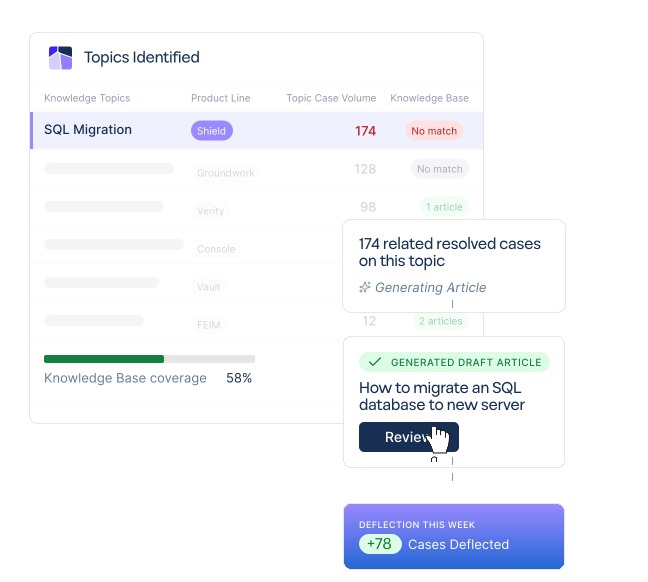
Mosaic AI's Knowledge user interface

Automatically discover and close your knowledge gaps

Most knowledge tools help you write. Mosaic tells you what to write by analyzing your resolved cases to rank the gaps by the support volume they drive, then turning your team's own resolutions into review-ready articles.

Book a demo
Trusted by technical support leaders at
HiBob logoRapid7 logoUnity logoClarivate logoCority logoAssetWorks logoYotpo logoPlanview logoPoint Rental by Aloupe logoPrismHR logoKaseya logo

Never investigate the same
issue twice

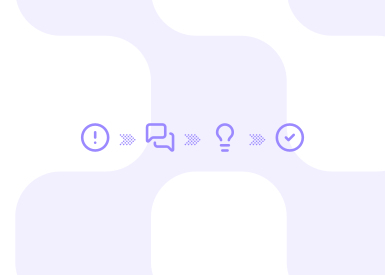
Your team already solved the case. Mosaic AI captures that resolution—and the troubleshooting behind it—drafts an article, gets it approved, and makes it available everywhere the next customer looks.

Know what to document

Identify recurring issues and the documentation gaps behind them.

Turn solved cases into review-ready articles

Draft new knowledge from real cases and troubleshooting.

Your experts approve it

Nothing is published without a human.

Stop the next ticket before it starts

That repeat volume never comes back.

The impact support teams see with Knowledge

Every gap Knowledge closes is volume that never comes back. These are the numbers that our customers see.

HiBob logo

800+

Support articles generated

AI-generated and enriched articles scale content creation automatically, keeping knowledge fresh and complete.

Read more
More
Point of Rental logo

92%

CSAT Score achieved

When customers get fast, accurate answers every time, satisfaction follows. Help support teams consistently deliver the quality of experience that earns top marks.

Read more
More
Cynet logo

43%

Reduction in intneral tickets

Minimized repetitive internal requests by automating answers and streamlining knowledge delivery.

Read more
More

How Knowledge works

Documentation goes stale because writing it competes with closing cases, and closing cases always wins. Knowledge removes the competition so the article is drafted from the case that just closed.

Book a demo

Find the gaps driving support demand

Every question your knowledge base can’t answer becomes another support case. Mosaic AI compares your resolved cases to existing documentation, identifies the knowledge gaps behind repeat cases, and drafts articles for your team to review and publish.

Organize knowledge by product

In highly configurable products, the right answer depends on the product, version, and configuration. Knowledge automatically organizes knowledge gaps and draft articles into configurable collections based on the product line.

Publish without changing your knowledge platform

Approved articles can be added to Mosaic’s internal knowledge base or published into your existing systems with your existing workflows. No migration required.

Keep experts in control

Every draft is routed through a configurable review workflow. Subject matter experts can verify the sources, edit the content, approve it for publication, keep it internal, or archive it. Nothing is published externally without the approval of your team.

100+ secure integrations, one unified source of truth

Half of what your team knows is not in the knowledge base; it's in Slack threads, closed cases, and one engineer's head. Because Knowledge runs on Mosaic's Customer Context Model, it can connect information across Salesforce, Slack, Confluence, SharePoint, Snowflake and 100+ systems without requiring migrations.

Context you can trustEvery article generated through Knowledge traces back to the cases and documents it came from, so a reviewer can check the source before it goes live.

Built-in governanceYou control what stays internal and what's published, with permissions inherited from every connected system.

One source of truthYour customer, your rep, and your AI all read the same Customer Context Model. Update it once, and the answer changes everywhere.

Support has always scaled with cost.
It doesn't have to.

Every Mosaic AI capability shares the same Customer Context Model, so each deployment expands what AI can understand, automate, and improve. Instead of adding disconnected point solutions, you build one platform that compounds in value over time, helping support scale while cost-to-serve continues to fall.

Knowledge is just one part of Mosaic AI

Knowledge is one capability built on the Mosaic AI platform. Because every module shares the same Customer Context Model, anything Knowledge learns immediately becomes available to Assist, Self-Service, Intelligence, and every capability you add later.

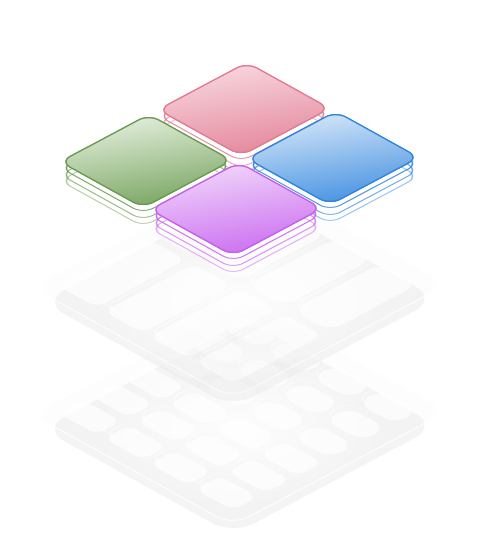
Diagram showing Mosaic AI product modules: Assist, Self Service, Knowledge, and Intelligence

Capabilities

With one set of integrations and a single Customer Context Model feeding every module, scattered case data turns into action automatically.

Assist
Self-Service
Knowledge
Intelligence
Diagram of Mosaic AI Customer Context Model unifying enterprise data sources

Customer Context Model

We transform siloed customer, product, and case data into one Customer Context Model, giving every Mosaic AI capability the context it needs to take the right action. Every capability acts from the same trustworthy source of truth, so answers come with citations, not guesswork.

Diagram showing Mosaic AI integration architecture connecting enterprise tools

Integrations

Connect the tools your teams already use: CRMs and help desks (Zendesk, Salesforce), knowledge bases (Confluence, Google Drive), and internal chat (Slack, Teams). 100+ connectors. No data migration. No engineering dependency.

Logos of integrations including Salesforce, Zendesk, Confluence, Slack, HubSpot, Jira, and 100+ more

See what your documentation is missing

We connect to your systems, run a proof-of-value pilot with your team, and show you the gaps in your own knowledge base. You know, those questions your customers keep asking that nothing answers? No engineering required. No upfront commitment.

Book a demo

Frequently Asked Questions

Get quick answers to your questions. To understand more, contact us.

Will AI publish content to our knowledge base without us approving it?

No. Knowledge drafts and your experts decide. Every article is sent to a subject matter expert who can verify the sources, edit the content, approve it, keep it internal, or archive it. Nothing reaches customers without your team's approval, and you control which systems Knowledge is allowed to draft from in the first place.

How does Mosaic AI know what our knowledge base is missing?

Mosaic AI analyzes the cases your team resolves. Knowledge uses those insights to group recurring topics. When a topic keeps generating cases but no article covers it, or the article that exists did not prevent the case—that is a gap. Those two signals tell you exactly what to write next, ranked by how much volume it would remove.

Where does the content come from? Is it just AI-generated?

It comes from your own resolutions, not the internet. Knowledge drafts from work your team already did—previously resolved cases, developer docs, Slack threads, and existing documentation—and cites every source. That's why it holds up in complex, multi-product environments.

How does Knowledge handle multiple products and versions?

This is what Mosaic AI is built for. Every article is structured and tagged against the Customer Context Model, which knows the product it applies to.

What results do teams see from automated knowledge?

By automating repetitive tasks like tagging, call notes, and FAQ updates, AI frees up time and speeds up ticket resolution.

How is this different from the AI in Zendesk or Confluence?

Confluence's AI helps you write and organize the content you already have, but it doesn't analyze your ticket queue to tell you what's missing. Zendesk has added its own gap-detection and ticket-to-article drafting, but it stays inside Zendesk's world. Mosaic AI's Knowledge runs on the same platform as Self-Service and Assist, so every article it publishes immediately starts deflecting cases and assisting reps, and every new case feeds back into what Knowledge drafts next. That compounding loop across all three, not gap-detection alone, is what a single add-on can't reproduce.