Mosaic AI announces launch of enterprise technical support platform
Learn More
SELF-SERVICE
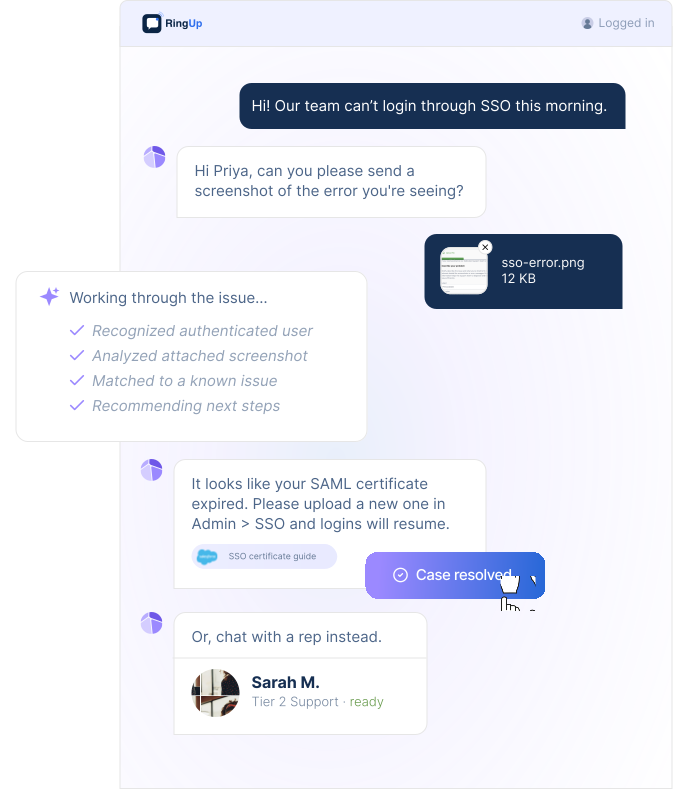
Mosaic AI's Knowledge user interface

Self-Service that troubleshoots

Mosaic AI troubleshoots technical issues using each customer's product, configuration, and case history, resolving more at the first touch and carrying the full investigation into support when a human is needed.

Book a demo
Trusted by technical support leaders at
HiBob logoRapid7 logoUnity logoClarivate logoCority logoAssetWorks logoYotpo logoPlanview logoPoint Rental by Aloupe logoPrismHR logoKaseya logo

Built to resolve more technical issues

Most self-service tools only deflect the questions your public knowledge base already answer. Mosaic AI investigates technical issues by asking follow-up questions, understanding screenshots and attachments, and combining customer, product, and support context to guide customers through resolution.

Fewer inbound tickets

Issues resolved before a case is ever opened.

Escalations start with full context

When a human is needed, the full investigation carries over. No one starts from scratch.

Faster resolutions

Customers get answers without waiting in a queue.

Higher rep productivity

Reps spend their time on complex cases, not repeat questions.

The impact support teams see with Self-Service

Real customers see real deflection numbers from complex, multi-product environments like yours.

Poing of Rental logo

95%

Of self-service conversations resolved without creating a case

At Point of Rental, 95%+ of self-service conversations now resolve without ever creating a case, cutting phone support from ~75% of volume to under 50% and freeing $375K to reinvest.

Read more
More
HiBob logo

25%

Reduction in ticket volume

A quarter of HiBob's inbound volume now resolves before it reaches a person, and every one of those is a case a rep never has to open.

Read more
More
Yotpo logo

20%

Fewer internal support tickets

Smarter self-service deflects repetitive inquiries, giving agents more time to focus on complex, high-value cases.

Read more
More

How Self-Service works

Self-Service meets customers wherever they seek help, works through technical issues the way your support team would, and carries every investigation into support when human expertise is needed.

Book a demo

Customer-specific troubleshooting

Every answer reflects the customer's environment, not just your documentation. Self-Service draws on 100+ connected systems, reads the screenshots and logs customers share, and cites every recommendation.

Works in the places customers ask

Deploy Self-Service in your help center, product, live chat, or directly inside your case submission flow to resolve technical issues that traditional self-service would immediately escalate.

Escalates with the full investigation attached

Every escalation starts with the investigation already complete. Self-Service carries the conversation, troubleshooting steps, attachments, and customer context directly into the support case or a live agent, so engineers pick up where AI left off.

Support has always scaled with cost. It doesn't have to.

Every new customer and product release adds support demand. Mosaic AI unifies customer, product, and support context across your systems, powering AI that resolves more, accelerates escalations, and keeps improving, so your support operation scales without matching it in headcount.

One source of truthEvery customer, engineer, and AI capability works from the same customer, product, and support context, delivering consistent answers and eliminating conflicting guidance.

Deflection that teaches the platformEvery question customers ask becomes a signal: What to document, what to fix, what to automate next.

Built for enterprise environmentsDeploy into the systems you already run with enterprise permissions, governance, and security built in, no migration or replacement required.

Self-Service is just one part of the Mosaic AI Platform

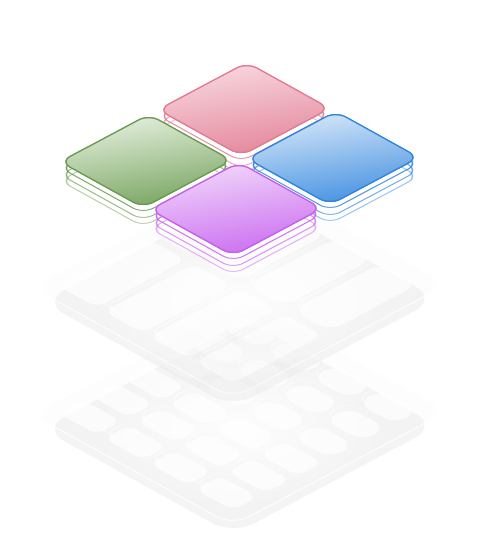
Self-Service is one capability built on the Mosaic AI platform. Because every module shares the same Customer Context Model, anything one capability captures immediately becomes available to Assist, Knowledge, Intelligence, and every capability you add later.

Diagram showing Mosaic AI product modules: Assist, Self Service, Knowledge, and Intelligence

Capabilities

All capabilities work from the same Customer Context Model, turning scattered information into resolved cases and resolved cases into ones that never happen.

Assist
Self-Service
Knowledge
Intelligence
Diagram of Mosaic AI Customer Context Model unifying enterprise data sources

Customer Context Model

The Customer Context Model turns the systems, knowledge, and workflows you already have into one context layer that's structured, enriched, permission-aware, and ready for AI to act on. Every answer and every action is grounded in your unique reality.

Diagram showing Mosaic AI integration architecture connecting enterprise tools

Integrations

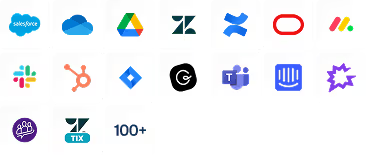
Connect the tools your teams already use: CRMs and help desks (Zendesk, Salesforce), knowledge bases (Confluence, Google Drive), and internal chat (Slack, Teams). 100+ connectors. No data migration. No engineering dependency.

Logos of integrations including Salesforce, Zendesk, Confluence, Slack, HubSpot, Jira, and 100+ more

See what your customers could be solving on their own

We connect to your systems, run a proof-of-value pilot with your team, and hand you a deflection business case built on your own case data. No engineering required. No upfront commitment.

Book a demo

Frequently Asked Questions

Get quick answers to your questions. To understand more, contact us.

How much can Mosaic AI Self-Service actually deflect?

It depends on your documentation and your product complexity, which is why we measure it on your own data during a pilot. At Point of Rental, 95%+ of self-service conversations resolve without ever creating a case. HiBob cut ticket volume 25%. Yotpo cut internal tickets 20%.

Why do most self-service bots fail in complex, multi-product environments?

Because they answer from documentation without knowing who is asking. In a multi-product, highly configurable environment, the right answer depends on which product the customer runs, which version, and how it is set up. A bot that does not know that will confidently give the wrong answer and generate a ticket plus a complaint. Mosaic AI answers from the Customer Context Model, so the answer fits the customer in front of it.

Where can customers reach Self-Service?

At case submission, in your customer portal, inside your product, and over email. Answerable cases get resolved at the point they would have been created. Mosaic AI connects to Salesforce, Zendesk, Confluence, and 100+ enterprise systems with no data migration.

How does deflection improve over time?

Knowledge clusters recurring gaps and drafts new articles, and Self-Service immediately begins using them. So next quarter, questions that generated tickets this quarter deflect on their own. Most self-service tools plateau at the edge of your existing documentation. This one does not.

What happens when Self-Service cannot answer?

When Mosaic AI determines a human is needed, Self-Service hands off the complete conversation, the customer's product and configuration, and everything Self-Service has already tried, so nobody starts from scratch, and the customer never repeats themselves. Point of Rental reached a 90%+ CSAT for the first time in company history by running this way.

How does Mosaic AI keep self-service answers accurate and brand-safe?

Every answer is grounded in your trusted source of truth and cited back to it. The Customer Context Model governs what Self-Service is allowed to access. It's allowed to say what stays internal, and it only ever uses content the customer is authorized to see. When it is not confident, it hands off rather than guessing.

What makes Mosaic AI's Self-Service different from Zendesk AI, Salesforce Agentforce, or Copilot?

Those tools deflect from a help center. Mosaic AI is built for technical support in highly configurable, multi-product enterprises, so Self-Service answers from the product and configuration each customer actually runs. And because Knowledge closes the gaps it finds, the deflection rate climbs instead of flattening. That is a platform behavior an add-on cannot reproduce.