








Key takeaways
About Rapid7
Rapid7 is a global cybersecurity company with over 11,000 customers, providing solutions to help organizations detect and respond to threats. The company operates a large-scale customer-facing organization, including a global workforce of 500+ support agents, customer success managers, and solutions engineers. Rapid7 handles 7k+ complex support tickets monthly and is focused on delivering timely and accurate responses while improving efficiency across its frontline teams.
The Challenge
Rapid7 initially set out to improve the efficiency and performance of its Support team. As customer demands grew, the company needed a scalable way to streamline knowledge access, reduce resolution times, and maintain high CSAT. Clear ROI from the Support use cases revealed broader opportunities across other frontline teams, including CS and Solutions Engineering where similar challenges were slowing responsiveness and straining capacity.
“Our goal was to create more capacity across Support, CS, and SE while working toward consistently hitting a CSAT of 95%.” —Rahat Nehal, VP Global Support
The Solution
Rapid7 integrated Mosaic AI across its core systems to give frontline teams instant, AI-powered support within their workflows, while enforcing an "Ask AI first" policy to boost efficiency and reduce escalations. Automation features like one-click summaries and text editing further streamlined daily tasks.
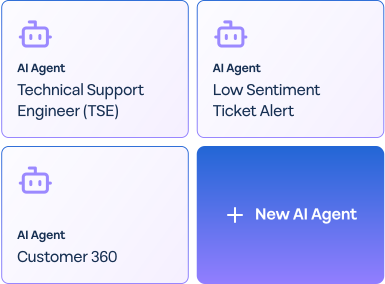
The Support team then expanded their use of Mosaic AI to automate workflows and replace fragmented tools—aiming to deliver a better external search and self-service experience, along with deeper, more actionable insights and alerts for the team.
Encouraged by the early results in Support, Rapid7 extended Mosaic AI across other GTM teams, unlocking cross-team knowledge sharing and a more unified customer experience.
Rapid7’s Proven Playbook to Deploying AI Across Frontline Teams
Step 1: Assessed Security & Compliance
Rapid7 conducted a detailed security review and compliance assessment to ensure Mosaic AI met enterprise-grade security requirements.
"One of the first things we did was a thorough security and compliance review. We had Mosaic AI up and running in under a month, which is incredibly fast for a tool like this."
—Rahat Nehal, VP Global Support
Step 2: Integrated Tech Stack
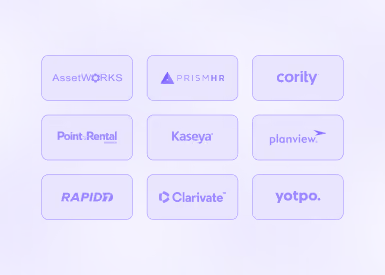
To provide seamless access to information, Rapid7 integrated Mosaic AI with its core business systems. This allowed frontline teams to access knowledge across multiple apps effortlessly.
Key Impact: Up and running in days
Step 3: Gave Reps Access to a Simple UI
Mosaic AI's AI Assistant was embedded into reps' workflows—sitting on top of their browsers and available in Slack to provide instant assistance.
"The AI is always on, whether in Slack or in the rep’s browser. This meant our teams could get instant answers and reduce back-and-forth."
—Rahat Nehal, VP Global Support
Key Impact: 30% Faster Ticket Handling Time
Step 4: Drove Behavior Change with an AI-First Mandate
Rapid7 implemented a policy where teams were required to ask AI first before escalating inquiries. If AI couldn’t provide an answer, it facilitated interaction with an expert on the agent’s behalf.
"We made it a mandate: Mosaic AI first. This was key to shifting behavior and driving adoption."
—Rahat Nehal, VP Global Support
Key Impact: 35% Increase in Agent Capacity
Step 5: Built Automations
Rapid7 leveraged Mosaic AI's automation capabilities to speed up everyday tasks. One-click actions like summarizing tickets, rephrasing text, and fixing grammar helped reps work more efficiently.
Key Impact: 95% CSAT
Step 6: Expanded Across GTM Teams
While Rapid7 initially started with technical support, the team quickly learned the benefits of leveraging Mosaic AI across other teams like CS and Sales Engineering.
“We see plenty of opportunities where it’s going to help us streamline our customer interactions and make us more efficient and effective.”
—Mike Gibson, SVP, Customer Success
Key Considerations
1. Enhance team performance with AI
“Rapid7 was able to improve service quality at its support centers by embedding AI directly into frontline workflows and mandating usage through operational playbooks.”
2. Strong knowledge foundations unlock AI value
“The better your inputs, the greater the return. Even if your knowledge strategy isn't fully mature, investing in clear, consistent documentation—like articles, playbooks, or shared FAQs—can significantly boost AI effectiveness.”
3. Think beyond one team—AI adoption spreads
“Once AI proves successful in one team, others will quickly see the value. Anticipate demand from adjacent teams and align early with both internal stakeholders and your tech partner to scale effectively.”
By starting with Support and scaling to Sales Engineering, Rapid7 has built a repeatable model for AI-powered service. The result: faster, smarter, and more helpful customer interactions—across the entire frontline.
“Mosaic AI puts the technical information at the fingertips of our customer-facing resources, allowing us to deliver customer outcomes at lightning speed.”
—Mike Gibson, SVP, Customer Success
"Mosaic AI has been a game-changer for our frontline teams. It’s not just about support—it’s about enabling every customer-facing role to be more effective."
—Rahat Nehal, VP Global Support
About Mosaic AI
Mosaic is the world’s first AI-native platform purpose-built for B2B Support teams. The Mosaic AI platform delivers faster resolutions, smarter decisions, and measurable ROI for B2B Support leaders in complex enterprise environments.