
















Key takeaways
Today is an important moment for our company.
We’re announcing a new name for our native AI platform: Mosaic AI.
If you’ve known us as Ask-AI, here’s what hasn’t changed: the team, the mission, and the trust we’ve built with our customers.
What has changed is the scope of the problem we’re solving, and the platform we’re building to solve it.
This new brand reflects our broader mandate and ambition.
Mosaic AI is not a cosmetic change. It’s the result of what we’ve learned building Ask-AI inside real B2B enterprises, and where that learning has taken us: an AI-native platform purpose-built to help B2B Support, CX and GTM teams master complexity and turn every customer interaction into actionable intelligence.
Why we chose the name Mosaic
A mosaic is made up of many individual pieces, but its true value lies in the complete picture.
That idea maps directly to the reality of modern B2B enterprises.
B2B Support, CX and GTM leaders are surrounded by critical signals: tickets, calls, chats, product usage data, CRM records, knowledge content, internal documentation, and operational workflows. The problem isn’t a lack of data. It is that the data is siloed, disconnected, and difficult to interpret in the moment that it matters.
Mosaic AI brings those pieces together.
We unify an organization’s data, knowledge, and insight to deliver the clarity and context teams need to make confident decisions faster, and with less manual effort.
This is what Mosaic AI is designed to do: turn fragmented inputs into a complete, actionable picture.
Why we focused on B2B Support as a critical entry point for enterprise AI adoption
Because no one else is.
The AI landscape is crowded with bots built to automate high volumes of low-complexity interactions, and with incumbent vendors promising “AI add-ons” that don’t address the real challenges Support and CX leaders face.
But B2B Support is different.
Enterprise Support organizations operate in a world of complexity:
- multiple products and customer environments
- deeply technical issues
- cross-functional dependencies
- high expectations for responsiveness and expertise
Traditional tools weren’t built for this reality. They help teams react, but not anticipate. They measure throughput, but not trust. And they don’t create the intelligence layer Support leaders need to scale impact without scaling headcount.
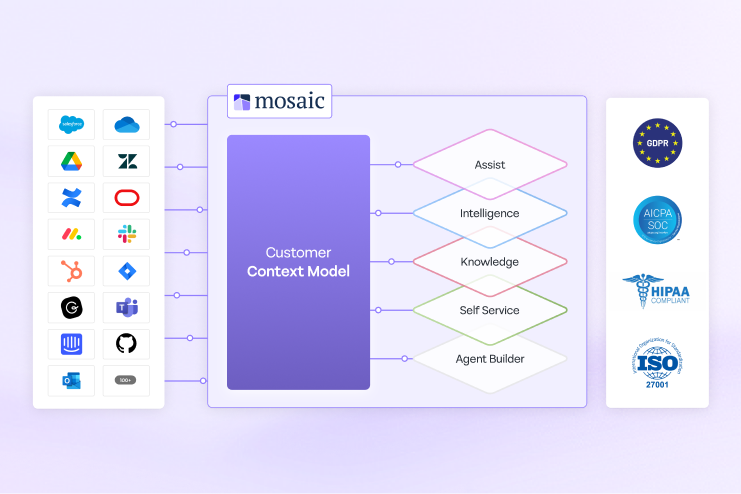
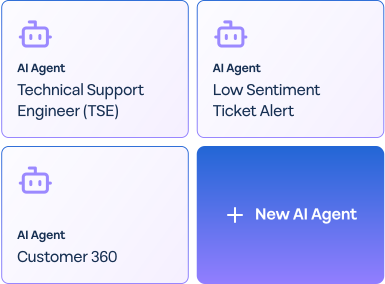
Mosaic AI is purpose-built for that world. Our wide range of integrations enable you to quickly and securely integrate the tools your teams already use, from CRMs and ticketing systems to knowledge bases and internal chat tools. Our platform transforms raw, siloed data into a unified, AI-ready context model, ensuring it is structured, enriched with customer context, and immediately usable by AI agents. And our four core products—an AI assistant, an AI self service help desk, AI-driven intelligence, and AI knowledge automation—work together seamlessly to accelerate resolutions and improve customer experience.
What Mosaic AI enables
Mosaic AI helps Support and CX organizations move from reactive firefighting to proactive, insight-driven support across every customer touchpoint.
Our goal is simple: provide leaders with the intelligence and visibility to stay ahead of issues, reduce operational overhead, and strengthen the customer experience.
With Mosaic AI, teams can:
- Identify risks and emerging issues before they escalate
- Gain visibility into customer trends and product health
- Improve rep productivity and resolution times
- Turn every interaction into learning that improves outcomes over time
This isn’t just a new name. It’s the foundation we’ve built, and the expanded product vision we are working to bring to life in the weeks and months ahead.
Beyond Support: Expanding Mosaic AI across CX and GTM teams
While Mosaic AI is purpose-built for B2B Support, our customers have extended its impact well beyond faster ticket resolution.
When you unify signals across Support, Customer Success, and GTM teams, you don’t just solve problems faster, you make better business decisions earlier.
Mosaic AI helps teams:
- turn recurring issues into product action, so tickets don’t need to be created in the first place
- build a true 360° understanding of the customer, grounded in real interactions and context
- detect renewal risk sooner, by connecting operational signals to customer health and outcomes
That’s the broader opportunity ahead: Mosaic AI as the intelligence layer that strengthens the entire customer experience and helps go-to-market teams act with clarity, alignment, and confidence.
We’re excited to show what Mosaic AI is becoming, and to keep building it alongside the teams who live this complexity every day.
Alon Talmor
CEO & Founder, Mosaic by Ask-AI