
Key takeaways
- Handling cases faster does not reduce how many arrive.
- The key to reducing support ticket volume is to remove them at the source.
- Only 20% of service leaders have cut agent staffing because of AI, while 55% report stable staffing while handling higher volumes.
- Volume comes from three places: issues that recur because nothing was documented, questions that are answerable but not findable, and cases that arrive without the context needed to resolve them.
- Contact rate per customer and repeat case rate tell you whether volume actually fell or your business simply stopped growing.
At one point or another, every support leader has been handed a brief that requires their team to absorb more volume, hold the line on cost, and do it all without adding more people. The instruction is given as if the solution is obvious.
It is not obvious, and most of the obvious answers are wrong. Cutting handle time squeezes an already-tight process. Pushing customers toward a help center they have already failed to find answers in moves the failure rather than fixing it. Hiring solves it and is the one option off the table.
What actually works is to remove volume at its source, which means finding the cases that should never have been created and eliminating the reason they were.
What reduces support ticket volume?
Removing the reason a case gets opened. Everything else changes what happens after it arrives.
That distinction is worth holding onto, because three different initiatives get filed under "reduce support tickets" and only one of them actually does it:
- Faster handling improves cost per case and does nothing to volume.
- Deflection prevents case creation, which is real reduction, but only for issues your self-service layer can genuinely resolve.
- Root-cause removal stops the issue recurring at all, which is the only lever that compounds.
A serious volume program runs all three, in that order of increasing difficulty and increasing payoff. Most stall at the first because it is the one that requires no cross-functional cooperation.
There is also a hard ceiling worth knowing before you set a target. For enterprise technical support, the realistically automatable share of volume is 15% to 30%, not the 80% or 90% that vendors quote from consumer support environments. Plan against a realistic number, and the program survives its first business review.
Why is headcount the wrong lever?
Because the goal was never fewer people. It was more capability per person, and the data now says most teams get there without cutting anyone.
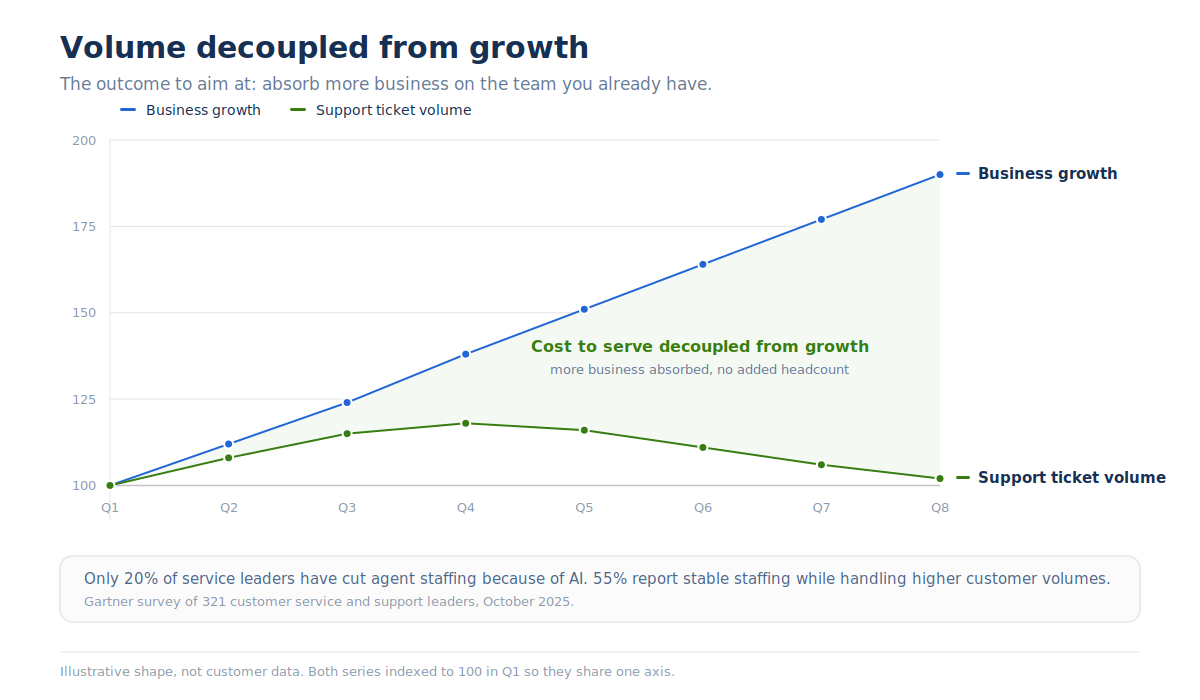
Gartner's December 2025 survey of 321 customer service and support leaders found that only 20% had reduced agent staffing because of AI. What the majority reported instead is more useful: 55% held staffing stable while handling higher customer volumes, and 42% were hiring specialized roles such as automation analysts. Gartner's own guidance is to stop framing AI around headcount, and to focus on augmentation instead.
Volume decoupled from growth, on the team you already have is the outcome to aim for.
"When we're talking to customers, I think the common trend is that all customers are trying to figure out how to expand their support capabilities without just adding headcount into the mix. They're either trying to figure out how to reduce their case volumes, or they're trying to figure out how to make the cases that they do take in actually be resolved more effectively, or they're trying to think at a more strategic level around how can I use the data we have access to to improve these systems." — Josh Solomon, GM & VP of Revenue, Mosaic AI
The pressure is real, and it is nearly universal. A 2006 Gartner survey of the same panel found 91% of service and support leaders under pressure from executive leadership to implement AI, which is precisely why the framing matters A program sold on headcount reduction fails its own success criteria, while the same work sold on absorbing growth without adding cost succeeds on the evidence above.
Where the volume comes from
Three sources, and the fix for each is different. Teams that treat volume as one undifferentiated flood tend to attack the most visible part rather than the largest.
The fourth row matters a lot. A team that documents everything degrades its own retrieval accuracy and spends reviewer time on content that will never prevent a case. Volume reduction is a prioritization exercise before it is an automation exercise.
How Mosaic helps: Mosaic AI attacks volume on all three fronts from one platform, on top of the stack you already run. Self-Service resolves straightforward cases before they become tickets and [resolves up to 30% of tickets automatically](https://getmosaic.ai/book-a-demo). Knowledge finds the recurring issues driving volume, compares them against existing documentation, and drafts articles from real resolutions so the same issue stops arriving. Intelligence surfaces the product and process patterns behind repeat cases so they can be fixed at the source rather than absorbed forever.
When support stops being a cost center
A support organization that is underwater cannot do anything except clear its queue. Every strategic conversation loses to the backlog, because the backlog is measured daily and strategy is not. Remove enough avoidable volume and the team gets capacity to think, which is a different kind of return than cost per case.
"By providing intelligent self-service and by being able to provide the tools to get employees and support engineers to resolve cases effectively, you start to give the support organization this opportunity to become a strategic function and to think at a strategic level, because they're not worried about escalations and the backlog they've been dealing with."— Josh Solomon, GM & VP of Revenue, Mosaic AI
The market is already moving this way. According to Gartner research, nearly 80% of organizations plan to transition agents into new roles, and 58% intend to upskill agents into knowledge management specialists. The volume you remove does not become a smaller team. It becomes a team doing work that prevents the next wave.
What to measure instead of ticket count
Raw ticket count is a treacherous target, because it falls for reasons that have nothing to do with you. Lose a large customer and volume drops. Ship fewer features and volume drops. Neither is a win, and a dashboard that celebrates both will eventually be caught out.
Four measures hold up better.
- Contact rate per customer or per account. Volume normalized against the size of the business, which is the only version of the number that survives growth.
- Repeat case rate on documented topics. If you published against a cluster and the cases keep arriving, the article is unfindable or wrong. This is the closed loop.
- Cost per case closed. Your own figure, which turns any volume reduction into a number finance recognises.
- Share of volume that is avoidable. The ceiling on the program, and the thing that should shrink as root causes get fixed.
Report the first two to the support organization and the last two to the executive who set the brief. They are answering different questions with the same underlying work.
Mosaic AI helps you start with the volume you can remove
If you have been handed the absorb-more-with-the-same-team brief, the sequence is not mysterious. Find out which recurring issues generate the most cases, work out which of those are genuinely resolvable without a human, and remove them at the source. Then look at what the remaining cases have in common, because that is where the next round of avoidable volume is hiding.
The number to promise upward is not a headcount saving. It is volume decoupled from growth, which is both more defensible and, on the evidence, more achievable.
Book a demo and we will show you where your avoidable volume actually sits, using your own case history.
Frequently asked questions
How do you reduce support tickets without hiring?
By removing the reason cases get created rather than processing them faster. That means resolving straightforward issues in self-service before a case exists, documenting recurring issues so they stop generating repeat contacts, and fixing the product or process causes behind clusters of cases. Handling cases faster reduces cost per case, not volume.
What is a realistic reduction in support ticket volume?
For enterprise technical support, the realistically automatable share of volume is roughly 15% to 30%. Higher figures generally come from high-volume, low-complexity consumer support, where the case mix is fundamentally different. Planning against the honest range is what keeps a program credible past its first review.
Does AI in customer support reduce headcount?
Mostly it has not. Gartner found only 20% of service leaders had reduced agent staffing because of AI, while 55% held staffing stable while handling higher volumes. Gartner separately predicts that half the organizations expecting significant AI-driven headcount cuts will abandon those plans by 2027.
What is the difference between ticket deflection and ticket reduction?
Deflection prevents a specific case from being created, usually by resolving the issue in self-service. Reduction is the broader outcome and includes deflection plus removing the root causes that generate cases repeatedly. Deflection is a mechanism; reduction is the result.
Which support tickets should you not try to eliminate?
One-off issues from incidents, outages, or rare configurations. They do not recur, so documenting them adds content nobody will search for, dilutes retrieval accuracy in self-service, and consumes reviewer time that recurring issues need.
How do you measure whether support ticket volume actually fell?
Track contact rate per customer or per account rather than raw ticket count, since raw count also falls when the business shrinks. Alongside it, track repeat case rate on topics you have documented, which tells you whether the fix worked, and cost per case closed, which converts the reduction into a figure finance recognises.