
Key takeaways
- Ticket deflection is the share of support requests resolved without a case being created. For enterprise technical support the realistic range is 15 to 30%.
- Gartner's 2024 survey found self-service fully resolves 14% of issues, which matches what we see in customer case data.
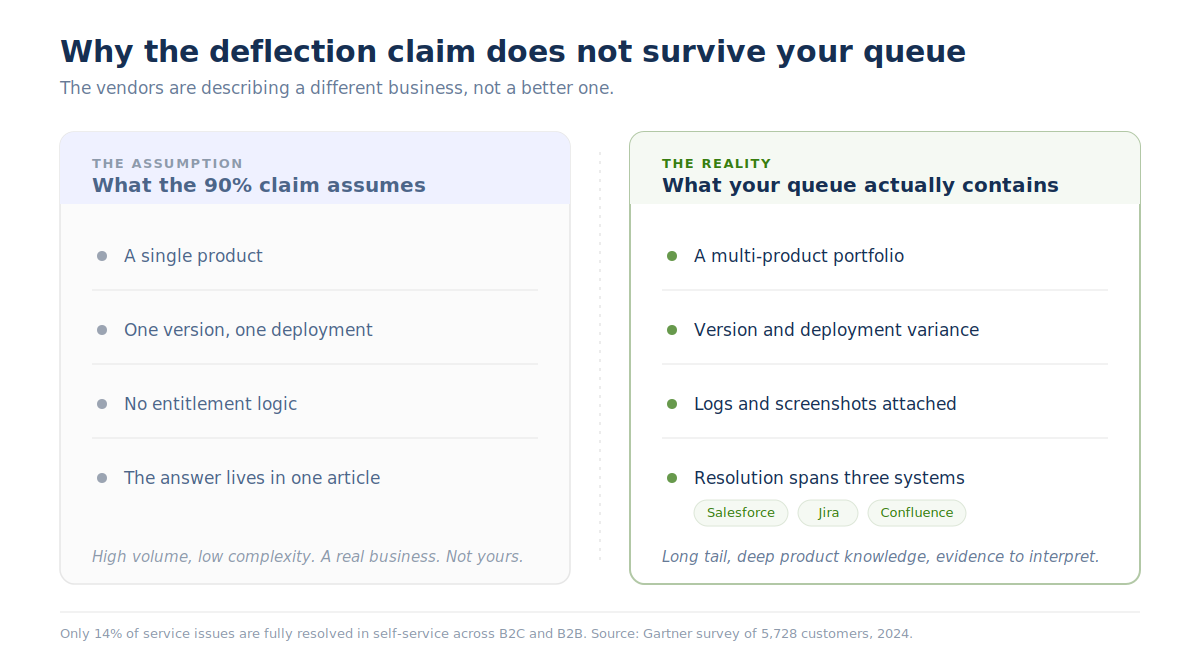
- The 80 to 90% claims come from high-volume, low-complexity B2C support, where one article answers thousands of contacts.
- Measure cases prevented, not conversation volume. A bot with 10,000 sessions that prevents 200 cases is deflecting roughly 2%, however busy the dashboard looks.
If you run support for a multi-product enterprise software company, the honest planning figure for ticket deflection is 15 to 30% of inbound volume. That range is worth more than a bigger number you cannot hit, because it produces a business case that survives its first quarterly review. In the article below, we’ll cover:where the inflated figures come from, what the real range looks like, and the four metrics to put in front of your CFO. If you want the same analysis run against your own case data, book a discovery call, and we will size the automatable share of your volume based on your real case complexity before you commit to anything.
What is ticket deflection?
Ticket deflection is resolving a customer's issue through self-service so that no support case is ever created. Case deflection means the same thing in Salesforce-centric organizations, where the object is a Case rather than a ticket. Salesforce publishes the standard formula in its own case deflection guide:
Deflection rate = successful deflections ÷ (successful deflections + created cases) × 100
Two clarifications, because both get muddled in vendor conversations.
Containment is a different measure. It records whether a conversation finished inside the self-service experience, which includes conversations that ended with the customer giving up, closing the tab, and emailing your team an hour later. Useful as a diagnostic, poor as a proxy for volume removed.
Deflection also does not mean blocking access. Customers notice when a form is designed to exhaust them, and in high-tier technical support they escalate through their account team instead. Our CEO, Alon Talmor, puts the design constraint plainly:
"It's not a rep trying to stop you from submitting a ticket. It's actually something trying to help you. If you want to submit a ticket, you can definitely do that, but some people do prefer self-service, it just needs to look like white glove self-service." —Alon Talmor, CEO & Founder, Mosaic AI
Why do vendors claim 80 to 90% deflection?
Because in the market those products were built for, the number is close to true. High-volume consumer support runs on a small set of repeated questions, where one article answers thousands of contacts and an FAQ bot with decent retrieval clears most of the queue. Josh Solomon, our GM and VP of Revenue, spent four years in that environment before moving to B2B:
"It’s a square peg, round hole type scenario. Vendors and the incumbent providers for their ticketing platforms have launched these initiatives to automate cases, but they're doing it primarily for an audience with high volumes of low complexity cases. But when you start to get into the nitty-gritty of what these teams really are focused on, there just isn't the same capability to make traction." —Josh Solomon, GM & VP of Revenue, Mosaic AI
Your queue does not look like that. A single case might involve a customer on release 3 of one product, deployed on premises, with a config that interacts badly with a module they bought last year. The answer lives across Salesforce, Jira, Confluence, and nine years of closed cases. No article covers it, so no article deflects it.
What is a realistic ticket deflection rate for technical support?
When we start with a new customer, the first thing we do is analyze their historical case data and ask how much of it a knowledge-based answer could actually have resolved.
"Typically we see something between 15-30%. So it's dramatically different than the AI products that are out there that are promoting 80, 90%." —Josh Solomon, GM & VP of Revenue, Mosaic AI
Independent research points the same direction. Gartner's August 2024 survey of 5,728 customers found that 14% of customer service issues are fully resolved in self-service, and that even for issues customers rated "very simple," the figure reached only 36%. Meanwhile, 73% of customers use self-service somewhere in their journey, and 43% of those who started there could not find content relevant to their specific issue. That gap between attempted and resolved has moved slowly: the same research program reported 9% in 2019.
So 15 to 30% of enterprise technical volume is a defensible target, and at the top of that range it is worth serious money. The ceiling moves when the AI stops retrieving and starts troubleshooting, which is a different product category from the one most teams evaluated in 2024.
Which deflection metrics actually hold up?
Most self-service reporting counts activity, and your CFO is buying outcomes. These four metrics separate the two.
The last row is the one to fight for. When a customer is halfway through your case form, they have declared intent, so if AI resolves the issue and they abandon the submission you have a countable resolution rather than an inference about a browsing session. We wrote about that channel in AI inside the case submission form.
Gartner's 2024 survey of 265 customer service executives found nearly 9 in 10 journeys that start in self-service are ultimately resolved across multiple channels, so most sessions are one step in a longer path. What happens to the context when that path continues matters as much as the deflection number.
How to set a deflection target you can defend
Four steps, in the order we run them.
- Baseline against your own case data. Sample resolved cases and classify each by whether a knowledge-based answer could have closed it. You will land somewhere in the 15 to 30% band. Use your number, not ours.
- Weight by cost, not count. A deflected password question and a deflected multi-product configuration case are not worth the same. Multiply each cluster by your cost per case closed.
- Fix the definition of success before launch. Write down what counts as a deflection, who audits it, and how often. Teams that skip this argue about the number for two quarters instead of improving it.
- Instrument the failure path. Track what happens to the 70 to 85% that still becomes a case. If the conversation, attachments, and investigation carry into the case, deflection stops being your only return.
How Mosaic helps raise the ceiling
The 15 to 30% figure describes what a retrieval-based answer can resolve. Move the AI closer to what your engineers do and the addressable share grows.
Mosaic AI’s Self-Service works through technical issues rather than looking them up, using the customer's product, version, and entitlement context, asking clarifying questions before recommending a step, and reading the screenshots and log files customers attach. It deploys across help centers, portals, in-product experiences, live chat, and directly inside Salesforce case submission flows, so one AI experience covers the channels your customers already use. Self-Service resolves up to 30% of tickets automatically.
Knowledge is what compounds. Every case Self-Service could not resolve is evidence of a documentation gap, and Mosaic Knowledge clusters those cases, compares them against your knowledge base, and drafts review-ready articles from real resolutions. Newly published articles reach Self-Service automatically, so next quarter's ceiling is higher than this quarter's. That loop is the subject of the knowledge and self-service flywheel. For the wider case on decoupling support cost from growth, see scaling technical customer support without headcount, and for where deflection sits alongside MTTR and FDR, customer support metrics that matter.
Where to start
If you are being sold an 80% number, ask which industry it came from and what counted as a deflection. Then ask for the same analysis on your own case data. Book a demo and we will size the automatable share of your volume, weight it by your cost per case, and show what the first 90 days would realistically return.
Frequently asked questions
How much can Mosaic AI Self-Service actually deflect?
It depends on your documentation and your product complexity, which is why we measure it on your own data during a pilot. At Point of Rental, 95%+ of self-service conversations resolve without ever creating a case. HiBob cut ticket volume 25%. Yotpo cut internal tickets 20%.
How do you calculate deflection rate?
Divide successful deflections by the sum of successful deflections and created cases, then multiply by 100. The formula is simple; the definition of "successful deflection" is where the disagreement lives. Salesforce Experience Cloud, for example, fires a deflection signal when an authenticated user views content, says it helped, and then chooses not to create a case.
Is ticket deflection the same as case deflection?
Yes, in practice. Case deflection is the Salesforce-native term, since the underlying record is a Case.
How does Mosaic AI keep self-service answers accurate and brand-safe?
Every answer is grounded in your trusted source of truth and cited back to it. The Customer Context Model governs what Self-Service is allowed to access. It's allowed to say what stays internal, and it only ever uses content the customer is authorized to see. When it is not confident, it hands off rather than guessing.
Does ticket deflection hurt CSAT?
It does when self-service obstructs rather than resolves. Gartner found 43% of customers who started in self-service could not find content relevant to their issue, and those customers reach your queue frustrated. Self-service that troubleshoots properly and hands off with the conversation and attachments intact improves the assisted experience instead.
Can AI deflect complex technical cases?
Retrieval-based AI cannot. AI that investigates, reads log files and screenshots, checks configuration and entitlement, and asks clarifying questions moves well beyond the FAQ tier. That capability gap separates the 15% end of the range from the 30%.