
Key takeaways
- Standard metrics are lagging indicators, measuring what happened (not what's about to break)
- Context switching costs 15-30 minutes of recovery time per interruption
- 56% of service agents experience burnout; 69% of leaders cite attrition as a major challenge
- Deflection-before-escalation rate is the most critical metric for scaling without adding headcount
- Balance customer satisfaction with employee satisfaction for sustainable operations
- Track three dimensions: customer outcomes, operational efficiency, and team sustainability
Most customer service teams focus on customer-facing metrics. They measure response time, average resolution time, and customer satisfaction scores. This isn't inherently wrong—these are all valuable indicators—but these standard customer support metrics tell you what happened, not what's about to break.
The metrics top-performing teams track? How many times have subject matter experts been interrupted to answer questions that shouldn't have reached them, and how many hours of strategic work disappeared on repetitive escalations?
Richard Branson once said, "clients do not come first. Employees come first. If you take care of your employees, they will take care of the clients." For B2B customer support teams, that means protecting your experts' time and energy. Your customers' satisfaction is tied directly to your employees' satisfaction.
When your SMEs are productive instead of constantly interrupted, they're free to take care of your customers.
Why SME time protection matters
Protecting SME time isn't about making life easier for your most senior experts. It's about whether your entire support operation can scale without collapsing. Three factors make this the most critical operational metric that most teams ignore.
The burnout tax
Every B2B support team has experts who understand the product better than anyone else. They've been with the company for years, built features from scratch, and debugged the gnarliest of issues. When truly complex customer issues surface, they're the ones who can solve them. They're also the ones who know when a problem signals a deeper product issue versus a one-off edge case.
The problem is that these experts spend most of their time fielding questions that don't require their deep expertise. A customer service agent escalates because finding the answer takes longer than pinging the SME. Sure, the answer exists, but it's buried in documentation from two years ago, so it's easier to just ask. So the SME gets interrupted. Again. And again.
In fact, 77% of customer service representatives report that their workload and the complexity of customer issues have increased compared to a year ago. This has led to over 56% of service agents experiencing burnout in their job, and 69% of customer service decision-makers say agent attrition is a major challenge for their organization.
Every unnecessary escalation costs 20 to 40 minutes of expert time when you factor in context switching and returning to deep work. Research consistently shows that interruptions don't just steal the time spent on the interruption—they steal the 15 to 30 minutes afterward as the expert regains focus. Multiply that by 20 interruptions per day, and your SMEs aren't doing strategic work anymore; they're just reacting to an endless stream of questions.
Scaling without adding headcount
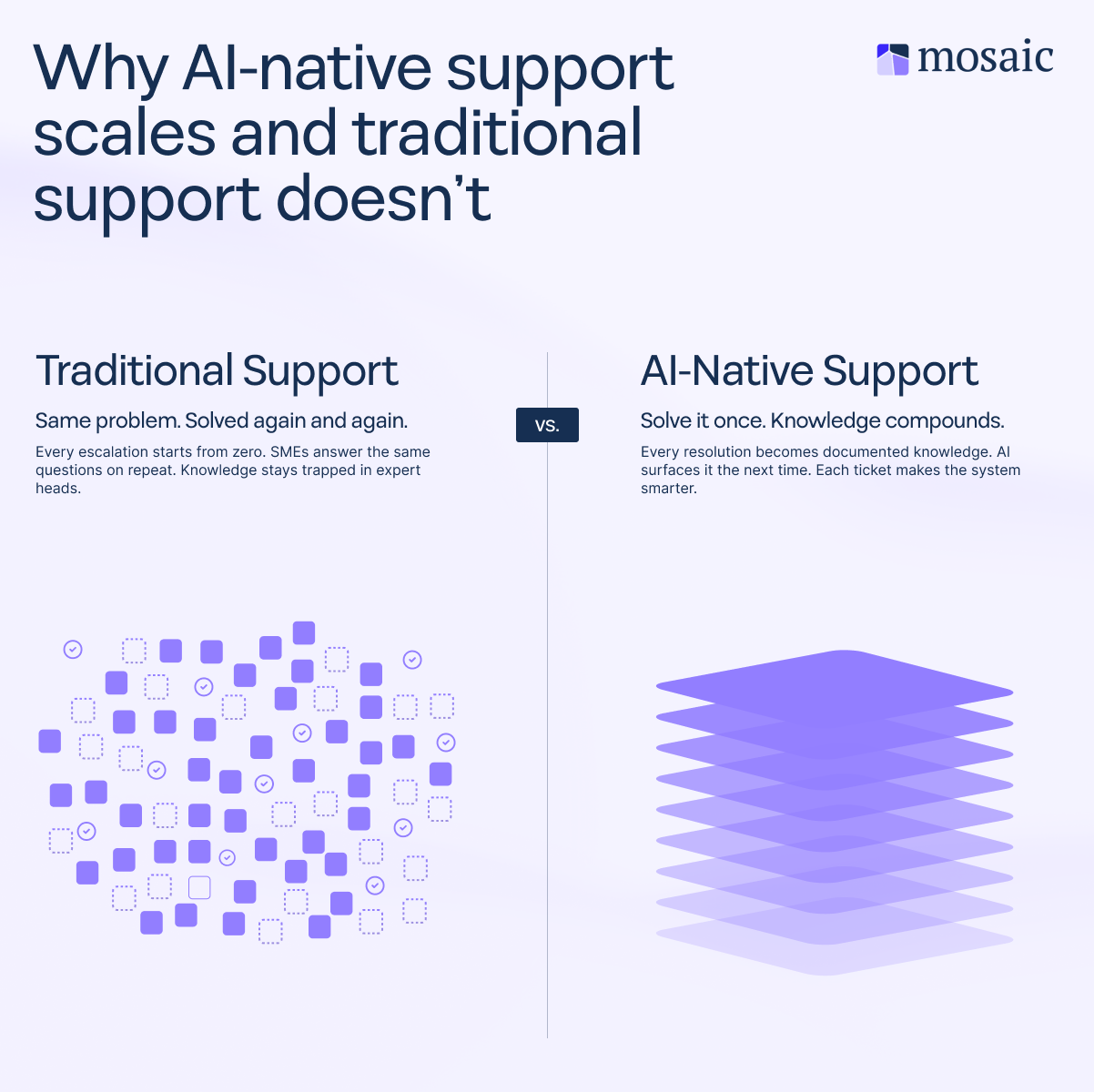
Scaling without hiring more customer support agents comes down to one question: Can you capture what’s in your SME’s heads and make it widely accessible? Achieve this, and you’ll unlock the secret of scaling the capabilities of your support team and deflecting most tickets before they even reach the experts at all.
This just makes sense when you think about it. When a SME resolves a complex issue, they should only have to do it once. Once their knowledge is documented and made accessible, then AI + human agents can ensure the solution is available the next time a similar case comes in. Rinse and repeat.
Companies that master this track things like:
- SME knowledge capture rate
- Escalation decay rate
- Deflection rates
- Knowledge reuse rate
They measure how much effort their support team expends before escalating, and they reduce that effort over time through better tools and documentation.
Industry research shows that 61% of customers would rather use self-service resources for simple issues instead of contacting a live agent. But the real scaling opportunity is two-fold: empowering customers to help themselves and empowering support agents with SME-level knowledge so they can assist customers without escalating when self-service isn’t enough. That's how you handle 2x the volume without 2x the headcount.
The retention risk
High-performing experts leave when they feel stuck answering the same questions instead of solving interesting problems. According to industry benchmarks, 60% of customer service agents say a lack of consumer data often causes negative experiences and support agents who use AI agents are 20% more likely to feel empowered to do their job well.
Where standard customer support metrics fall short
Essential customer service metrics aren't wrong; they're incomplete. When you view them through the lens of SME protection, you start asking different questions.
First response time doesn't catch triage issues
First response time tracks how quickly your customer service team acknowledges a customer request. Fast responses improve customer experience. But there's another clock that matters more: how long before an issue incorrectly reaches an SME.
When your time-to-SME is consistently low despite multiple support tiers, you have a triage problem. Issues that should be resolved at tier one are jumping straight to expensive resources.
Average resolution time doesn't always tell the full story
Average resolution time shows how long it takes to close support tickets. Lower is better... except when it isn't. Fast resolution times can mask an escalation crisis.
If your average resolution time is stellar but your SMEs work 60-hour weeks, you're not operating efficiently. You're burning out experts to maintain a number. Speed at the cost of sustainability isn't speed, it's debt.
"Most organizations assume that MTTR reflects resolution time, and by definition, it does. But in B2B support, up to 80% of that metric happens before troubleshooting even begins. The cost isn't in the fix. The cost is everything that's required before the fix can even begin."
— Tina Grubisa, Value Consultant at Mosaic AI
First contact resolution doesn't measure expert accessibility
First contact resolution (FCR) rate measures how often customer service agents resolve issues without escalation. High FCR means efficient service delivery and better customer engagement.
But FCR doesn't tell you whether frontline customer support agents have the tools they need or if they're just escalating less because experts are accessible.
The key metric to look at instead: first-tier resolution rate. This answers the question of how many customer inquiries are resolved before reaching experts.
Customer satisfaction score doesn't measure SME satisfaction
Customer satisfaction (CSAT) scores tell you whether you're meeting customer expectations. Tracking customer satisfaction is fundamental. Satisfied customers drive customer loyalty and reduce customer churn.
But CSAT doesn't capture whether your customer service operations are sustainable. You can deliver exceptional customer experiences while destroying your support team. If customer satisfaction is high while your experts are actively interviewing elsewhere, your metrics could be a lagging indicator of a crisis.
The customer service metrics to track
The metrics that actually predict your support organization's health are prospective. They identify patterns before they become crises.
SME escalation rate
SME escalation rate tracks the percentage of total customer support tickets requiring expert intervention. The trend matters more than the total number, as increasing escalation rates can signal that product complexity is outpacing knowledge base improvements.
Best-in-class B2B support teams see escalation rates decline over time as they systematically document expert knowledge. Every escalation becomes an opportunity to create content, preventing the next ten similar customer requests.
How AI helps: AI platforms, like Mosaic AI, track escalation trends in real time and automatically identify patterns that signal when product complexity is outpacing documentation. The system flags which topics are driving escalations so you can prioritize knowledge creation where it matters most.
Time-to-SME
Time-to-SME measures the number of customer interactions before expert involvement. For truly complex issues, low time-to-SME is ideal. For everything else, high time-to-SME is the goal.
When you see low time-to-SME on routine issues like password resets or documented procedures, you've identified a knowledge accessibility problem.
How AI helps: AI agent assist tools surface relevant knowledge and troubleshooting steps directly in the agent's workflow, increasing time-to-SME on routine issues by resolving them at tier one.
SME interruption frequency
Track how many times each SME gets pulled into support tickets per week. Context switching costs 15 to 30 minutes of productivity per interruption, according to a widely cited study by Gloria Mark of UC Irvine. Say your rep experiences twenty interruptions in one day, which means five to 10 hours spent recovering from context switches.
"Support doesn't lose time on the fix itself. It loses time every time context breaks. The fastest way to improve performance in your support organization is to reduce the mental gymnastics. Low-value work and rework is the unbudgeted cost center in every support organization."
— Tina Grubisa, Value Consultant at Mosaic AI
How AI helps: AI-powered triage analyzes incoming tickets and routes only genuinely complex issues to SMEs. Truly AI-powered platforms, like Mosaic AI, learn from historical escalation patterns to predict which tickets need expert involvement and which can be deflected through automation or agent assist.
Deflection-before-escalation rate
The most important customer service metric for scaling support without scaling headcount. This tracks the percentage of potential escalations resolved through automation, self-service, or agent assist before reaching experts. It's the difference between needing to hire three more SMEs next quarter versus deflecting the work that would have required them.
Calculate this by identifying tickets that match characteristics of historical escalations–same keywords, similar customer sentiment, comparable complexity–and measuring how many resolve at lower support tiers instead.
By solving this, your experts remain available for genuinely complex customer issues instead of being consumed by routine questions that should never reach them.
How AI helps: AI identifies tickets with escalation risk based on keywords, sentiment, and complexity, then proactively surfaces the exact documentation agents need.
Escalation accuracy rate
What percentage of escalations actually required expert knowledge? Have SMEs classify each escalation: did this truly need my expertise, or could this have been resolved with better documentation or training?
Track this weekly by having SMEs tag each escalation they receive with one of three categories:
- Required expertise
- Needed better documentation
- Shouldn't have escalated
Calculate the percentage that truly needed expert involvement. Low escalation accuracy could uncover real systemic problems.
How AI helps: AI analyzes historical escalation patterns to predict which incoming tickets are likely to escalate, then surfaces the exact knowledge agents need to resolve issues at tier one. Mosaic reduces unnecessary escalations before they happen—improving your escalation accuracy rate without adding manual SME review processes.
Knowledge capture and reuse rates
When an SME resolves a novel customer issue, how quickly does that solution become accessible to the broader support team?
Measure lag time between expert resolution and documented knowledge by tracking how often documented SME solutions prevent future escalations. High reuse rates indicate your customer support team trusts existing knowledge. Low reuse suggests discoverability or quality problems.
How AI helps: AI-powered platforms, like Mosaic AI, can analyze historical escalation patterns to predict which incoming tickets are likely to escalate, then surface the exact knowledge agents need to resolve issues at tier one. This reduces unnecessary escalations before they happen, improving your escalation accuracy rate without adding manual review processes.
Cost per SME interruption
Calculate the fully loaded cost of unnecessary SME escalations. Factor in:
- hourly rate,
- context-switching time,
- and opportunity cost of work not done.
For most B2B organizations, each unnecessary escalation costs hundreds (or even thousands) of dollars in expert time.
How AI helps: AI quantifies the business impact of unnecessary escalations by connecting ticket data to time spent and resolution patterns. These analytics show exactly how much expert time you're protecting through automation, making it easy to calculate ROI and justify AI investments to leadership.
Expert availability for strategic work
What percentage of SME time goes toward high-value activities versus reactive escalation handling? Strategic work includes analyzing customer feedback, improving documentation, training team members, and solving genuinely complex issues.
When experts spend 70% of their time on strategic work, they're functioning as experts. When they spend 70% on reactive escalations, you're paying expert salaries for work that should be automated. That's like paying a master chef to wash dishes.
How AI helps: AI takes repetitive escalations off experts' plates by automating routine answers and surfacing documentation for tier-one agents. Understanding what percentage of SME time goes to reactive work versus strategic initiatives gives you clear visibility into whether automation is actually freeing up expert capacity.
How to implement SME protection metrics
Implementing these customer service metrics requires more than adding fields to your ticketing system. You need to change how your organization thinks about customer service data. Start with these four steps.
1. Establish baselines
Start by understanding the current state. Track escalation volume, SME time allocation, and escalation accuracy for 30 days without changing anything. You're looking for patterns.
Ask SMEs to classify escalations for one month. Each escalation gets marked with one of:
- Required expertise
- Needed better documentation
- Shouldn't have escalated
2. Set up automated tracking
Integrate your ticketing system, knowledge base, and escalation workflows so customer service data flows automatically. Tag support tickets by complexity level and required expertise.
Modern customer service operations use predictive analytics to identify escalation-bound tickets before they reach experts. The system analyzes customer sentiment, technical indicators, and historical patterns.
Platforms like Mosaic AI take this a step further with deep, out-of-the-box integrations that go beyond basic API connections. Rather than simply pulling data from your systems, Mosaic AI's Customer Context Model acts as an AI Data ETL layer that automatically tags data by complexity, performs sentiment analysis, and correlates ticket data with customer account health, all in real time and without manual configuration.
3. Create feedback loops
Customer service metrics only improve performance when they drive action. Implement weekly escalation pattern reviews, examining unnecessary escalations and identifying root causes.
Monthly SME time protection audits look at the bigger picture. Are deflection rates improving? Is knowledge reuse increasing?
This does not have to be a manual process. AI-native platforms make creating feedback loops easy by automating them. You can see escalation trends, deflection rates, and knowledge reuse metrics in real time on centralized dashboards—no need to export data from multiple systems or build custom reports. The platform surfaces which knowledge gaps are driving escalations and tracks whether new documentation actually reduces repeat tickets.
Quarterly knowledge gap analysis identifies systematic problems requiring strategic investment.
4. Connect metrics to business success
Link deflection rate improvements to measurable outcomes. Show how reducing SME interruptions can free up your experts' time. Demonstrate how that time translated into product improvements or strategic initiatives.
Calculate the ROI of automation investments by comparing costs against the protected expert time value. Platforms like Mosaic AI connect ticket resolution data directly to which agents and AI tools were used, making it simple to show leadership exactly how much expert time you've protected and what that translates to in dollar value.
5 best practices to improve service quality and protect SME time
Once you're tracking the right customer support metrics, use them to drive systematic improvements.
Here are five best practices to follow that are guaranteed to produce results:
Optimize tiered routing
Use customer service metrics to optimize how customer requests flow through your support system. Then, analyze which customer interactions are resolved at each tier and adjust routing rules accordingly.
You know that drift that happens where more issues go to experts because it's easier than improving tier-one capabilities... we've all been there. You can prevent that escalation creep by measuring routing accuracy on an ongoing basis.
Identify knowledge gaps
Track patterns to identify where documentation needs to exist but doesn't. Analyze escalation patterns monthly, asking: what are the top ten reasons customer support agents escalate to experts?
Close the loop by measuring escalation reduction after new content creation.
Target automation strategically
Use customer service data to identify the highest ROI automation opportunities. Look for high-volume, low-complexity escalations where SMEs resolve issues in under 10 minutes using repeatable processes.
Balance multiple dimensions
Never optimize key customer service metrics in isolation. Include expert satisfaction alongside customer satisfaction. Track whether improvements to measure customer service performance come at the cost of employee well-being.
The best teams track three dimensions simultaneously: customer outcomes like satisfaction and retention, operational efficiency including resolution time and deflection rate, and team sustainability through expert availability and employee satisfaction.
Use AI to measure, track, and scale
Manual tracking of SME protection metrics doesn't scale. AI-native platforms like Mosaic AI make implementation practical by providing deep integrations that go beyond basic API connections. The Customer Context Model acts as an AI Data ETL layer, automatically cleaning, structuring, and enriching ticket data so it's AI-ready from day one.
This means automatic tracking of escalation patterns, sentiment analysis, complexity tagging, and correlation between tickets and customer account health as it happens (not as an afterthought). You can see SME interruption frequency, escalation accuracy rates, and deflection metrics without building custom dashboards or waiting months for data pipelines.
AI also enables the automation itself: intelligent routing that predicts ticket complexity, knowledge automation that identifies gaps and generates documentation, and no-code workflow builders that handle repetitive tasks. The platform tracks which agents and AI tools were used on each ticket, making it simple to calculate ROI and show leadership exactly how much expert time you've protected
Measure what matters: System health vs ticket throughput
Traditional customer service metrics measure ticket throughput. Companies that master customer service performance measure system health—whether experts can focus on complex customer issues or if they're drowning in routine escalations that automation should handle. Get this wrong, and you risk agent burnout, declining satisfaction, or your best people leaving.
Getting it right is the difference between reactive measurement and proactive support. By tracking metrics that protect expert availability, you transform support from a cost center into a strategic function that scales through intelligence.
Frequently asked questions about customer support metrics
What are the 4 most important metrics for customer service?
The four essential customer service metrics most teams track are customer satisfaction score (CSAT), net promoter score (NPS), first contact resolution rate (FCR), and average resolution time. These measure customer experience outcomes—satisfaction levels, recommendation likelihood, first-touch resolution, and problem resolution speed. They're important baseline indicators, but incomplete. They tell you whether customers are happy today, not whether your support model can sustain that happiness tomorrow. Add SME escalation rate, deflection-before-escalation rate, and expert availability for strategic work to measure whether your operations can scale without burning out your best people.
What are the best KPIs for customer support?
Key performance indicators for customer support typically include first response time, average resolution time, customer satisfaction scores, ticket volume, first contact resolution rate, customer effort score, and net promoter score. These track operational efficiency and customer sentiment. High-performing B2B support teams add a second layer focused on system sustainability: SME interruption frequency, escalation accuracy rate, knowledge reuse rate, cost per escalation, and time-to-SME. The first set tells you how you performed last quarter. The second set tells you whether you can maintain that performance without adding headcount or losing experts to burnout.
What is the 10 5 3 rule in customer service?
The 10 5 3 rule comes from hospitality—acknowledge customers at 10 feet, greet them at 5 feet, help them at 3 feet. In B2B customer support, the equivalent is response time transparency: acknowledge requests immediately, provide initial response within your SLA, and set clear resolution expectations. This translates to automated acknowledgments, intelligent triage routing issues correctly from the start, and proactive timeline communication. What matters most is eliminating customer anxiety about whether anyone is working on their problem.
What are the 7 C's of customer service?
The 7 C's of customer service are Clear, Concise, Concrete, Correct, Coherent, Complete, and Courteous—principles for effective communication. For B2B support teams, these are table stakes. Every representative should communicate clearly and courteously. But communication quality doesn't solve scalability. You can have perfect responses and still burn out subject matter experts by routing unnecessary escalations. The 7 C's tell you how to handle each interaction well. SME protection metrics tell you whether your team can handle increasing interactions sustainably. Both matter.