
Key takeaways
- The typical ticket escalation process focuses on managing escalations efficiently, not just preventing them
- B2B support teams experience unique escalation challenges: complex products, multi-stakeholder accounts, and technical depth requirements
- The hidden cost of escalations is slow resolution times, SME burnout, context loss, knowledge silos, plus strategic work that never gets done
- AI-native platforms reduce escalations by surfacing complete customer context, automating knowledge capture, and identifying patterns that reveal root causes
- Preventing escalations requires unified intelligence that only AI-native platforms are able to provide
- Measuring escalation reduction success means tracking tickets prevented, SME time protected, knowledge gaps identified, and the shift from being reactive to proactive
Here's the uncomfortable truth: most ticket escalation processes simply manage escalations when they should be reducing them.
B2B support teams face a unique escalation burden. Your products are complex. Your customers expect expert-level support. Your agents need deep technical knowledge, complete customer context, and access to scattered information across multiple systems. Traditional escalation workflows just shuffle tickets between people more quickly, rather than addressing why escalations happen.
Your support team's ticket escalation process probably looks something like this: Tickets get routed through tiers. Agents know when to escalate. You've got clear escalation criteria. SLAs are defined. All this, and yet your SMEs are drowning in escalations, your frontline agents are frustrated, and customers are waiting longer than they should.
So, in this guide, we're not going to show you how to manage escalations better. We're going to show you how to prevent them in the first place.
What is a ticket escalation process (and why it's not enough)
A ticket escalation process is the structured workflow support teams use to route customer issues from frontline agents to specialists, technical experts, or management when tickets can't be resolved at the first point of contact.
Most organizations structure their escalation process in tiers:
- Tier 0 includes customer self-service options like knowledge bases and chatbots, where customers attempt to resolve issues independently
- Tier 1 comprises frontline support agents who handle general customer queries and common issues
- Tier 2 consists of technical specialists with deeper product expertise who deal with complex tickets
- Tier 3 involves subject matter experts, product teams, or engineering resources for the most challenging problems
Before we continue, let's unpack the different types of escalations teams come across.
There are three main types of escalations
Hierarchical escalation moves a ticket up the authority chain within the same team – from agent to team lead to manager – typically when an issue calls for managerial approval or involves sensitive customer relationships.
Functional escalation moves a ticket laterally to a different team with specialized knowledge, such as from support to product team to engineering, when technical expertise beyond support's scope is required.
External escalation involves routing issues to vendors, partners, or third-party providers when resolution depends on systems or services outside your organization.
Traditionally, triggers are straightforward: Tickets escalate when complexity exceeds agent expertise, when SLA breach becomes imminent, when customers explicitly request to speak with more experienced agents, when high-priority issues like outages or security concerns occur, or when predefined escalation criteria are met.
But there is a fundamental problem with this approach. These processes assume escalations are inevitable, optimizing for speed and routing accuracy. They focus on getting escalated tickets to the right expert as quickly as possible. This isn't inherently wrong, but they aren't asking a more important question: why are we escalating so many tickets in the first place?
An effective ticket escalation process should be self-improving. Every escalation should make the next similar ticket less likely to escalate. But most organizations never close this loop.
Why traditional ticket escalation systems fall short in B2B
Most ticket escalation systems were designed for B2C support: high volume, low complexity, transactional interactions. A customer calls about a billing question. An agent can see the account, pull up the invoice, and resolve it in three minutes. The interaction is self-contained and simple.
B2B support is fundamentally different, and generic ticket escalation workflows break down under this complexity. Your SMEs become bottlenecks instead of strategic assets, your frontline agents lose confidence, and most importantly, your customers experience longer wait times and have to repeat themselves across multiple team members.
Product complexity demands deep context that keyword-based routing can't capture
Your customers aren't asking "How do I reset my password?"
They're asking, "Why is our API integration throwing timeout errors, specifically when we authenticate through Okta with custom user attributes?"
They're dealing with version-specific bugs, custom configurations, and integration challenges which require understanding not just your product but how it fits into their entire technology stack.
Generic escalation workflows route based on ticket categories or keyword matching. They don't understand that this customer has a unique implementation: they're running version 2.8 with specific customizations; that similar issues were resolved three months ago using a workaround that should be documented; or that their account includes multiple products with interdependencies. Without this context, agents either escalate prematurely or waste time reconstructing information that should be immediately available.
Disconnected systems create incomplete context that forces unnecessary escalations
An effective process requires complete customer visibility, including things like:
- Account configuration and history,
- Product usage patterns,
- Past support tickets and their resolutions,
- Current project status, and,
- Relationship health signals.
But this information lives scattered across multiple systems: your CRM holds account details, your ticketing platform tracks support history, your product database shows configuration, Slack threads contain internal discussions, and your knowledge base houses documentation.
When an agent needs to decide whether to escalate, they don't have time to piece together this puzzle across five different tools. So they make the safe choice and escalate an incomplete ticket. The specialist receiving it has to start from scratch, asking the customer to repeat information and hunting through the same disconnected systems. The ticket that should have been resolved in one interaction now takes three days and multiple handoffs.
Manual escalation processes don't scale as complexity grows
When you have 50 support tickets per day, agents can manually assess each one, decide whether escalation is necessary, fill out escalation forms with context, and tag the appropriate expert. At 500 tickets per day with growing product complexity, this manual approach breaks down completely. Agents default to escalation because it's faster than doing the investigation themselves. Your SMEs become overwhelmed, response times become longer, and customer dissatisfaction increases.
This isn't a problem you can solve by adding AI features to a legacy ticketing system. Bolted-on
AI can't bridge disconnected data sources or automatically capture knowledge from resolved escalations.
You need a platform built from the ground up to unify customer data, surface complete context in real time, and continuously learn from every ticket resolution. The difference between escalation management and escalation reduction is architectural.
The hidden cost of escalations in B2B support
Escalations impact customer satisfaction, which leads to plummeting CSAT scores—that's the most obvious cost. But there's also real damage happening inside your organization, compounding over time in ways that don't show up in traditional support metrics.
- SME time and expertise drain is perhaps the most significant hidden cost. Your subject matter experts didn't join your company to answer the same escalated tickets over and over. They joined to solve novel problems, build new features, or drive strategic initiatives. But when frontline agents lack context or can't access the right information, escalations become routine. When SMEs spend hours each week on issues that shouldn't reach them, you're burning your most valuable resources on preventable problems while critical work goes undone.
- Context switching and knowledge loss happen with every escalation handoff. The customer explains their issue to a frontline agent. The agent documents what they tried and escalates to a specialist. The specialist reads the notes, finds them incomplete, and asks the customer to re-explain everything. The customer repeats themselves, frustrated that they're starting over. By the time the ticket reaches someone who can actually solve it, critical details have been lost in translation. What should have been a straightforward resolution becomes a multi-day investigation because no one has the complete picture. This isn't just a frustrating experience; it's an expensive one.
- Frontline agent confidence and burnout follow predictably from frequent escalations. When agents escalate regularly, it signals they don't have what they need to succeed. They lose confidence in their ability to resolve complex issues. This learned helplessness is toxic for team morale and your support operations become a training ground for other companies instead of a place where expertise compounds over time.
- Knowledge silos that compound over time might be the most insidious hidden cost. When escalations get resolved by experts, that knowledge rarely makes it back to frontline agents or documentation. The SME solves the problem, closes the ticket, and moves on to the next fire. The same issue escalates again next week. This creates a knowledge distribution problem that gets worse as your product evolves and the gap between what your best agents know and what your average agents know keeps growing, forcing escalation rates higher.
The opportunity cost of reactive support keeps VPs of Support up at night. B2B escalations are particularly costly because the stakes are higher across the board. Complex products require specialized technical knowledge that takes months or years to develop. You can't just hire more people and expect them to handle escalations competently. Multi-stakeholder accounts mean escalations impact entire organizations, not just individual users, multiplying the business risk.
"Escalations have a much more significant impact than they realize. It's a bottleneck that can be removed rather easily." - Tina Grubisa, Value Consultant at Mosaic AI
The customers escalating are often your largest, highest-value accounts where retention directly impacts revenue. And escalation patterns reveal product gaps and competitive vulnerabilities, but only if you're measuring the right things and connecting escalation data to strategic decisions.
The goal isn't faster escalations. It's fewer escalations. And that requires rethinking how customer support operations work from the ground up.
Building an effective ticket escalation process for B2B teams
An effective escalation process requires building a system where escalation becomes the exception, not the default.
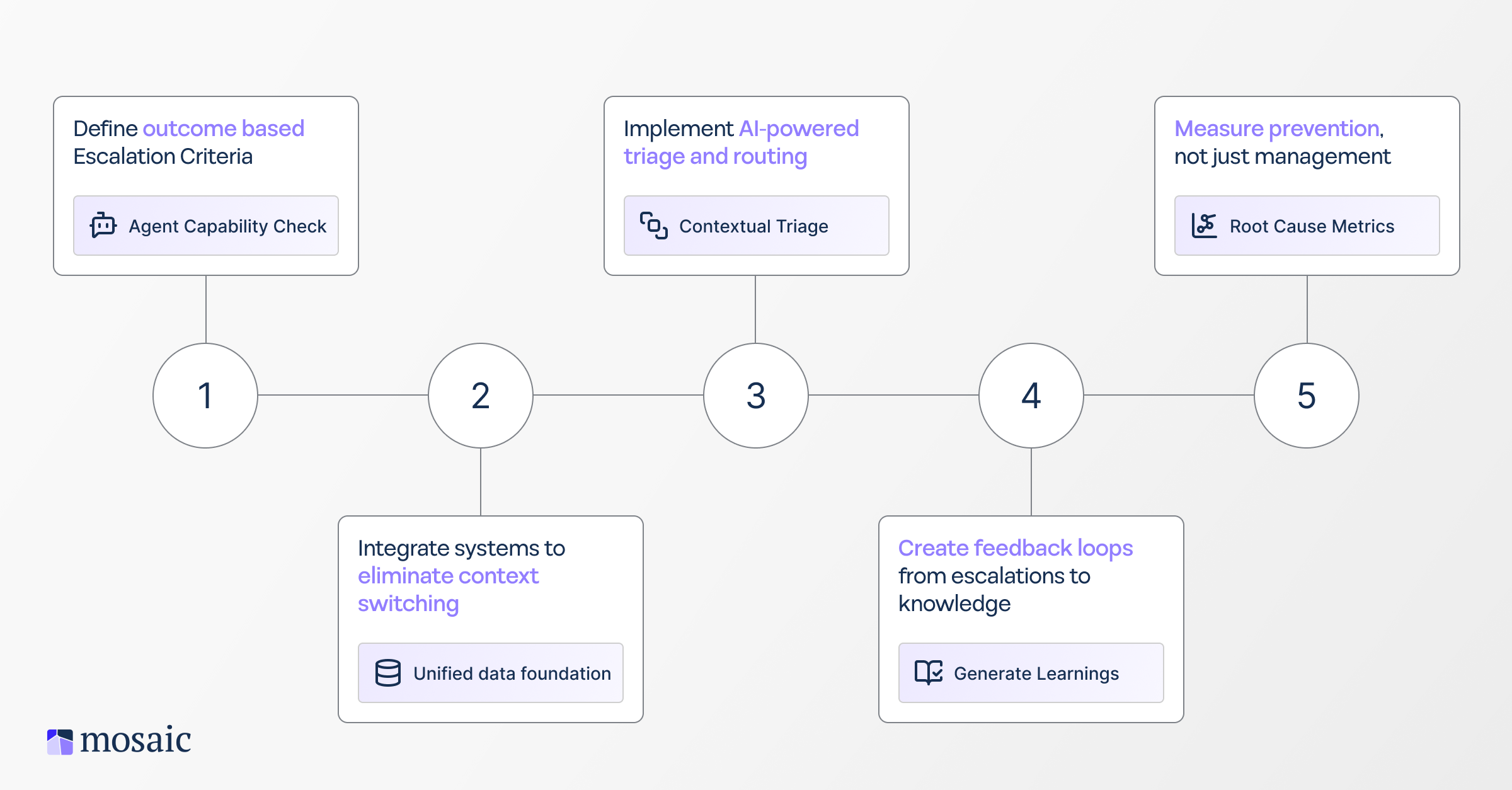
1. Define outcome-based escalation criteria
Traditional escalation criteria focus on ticket attributes: escalate if it's a billing issue over $10,000, escalate if it mentions security. These rules are easy to automate but terrible at preventing unnecessary escalations.
Better escalation criteria focus on whether the agent has what they need to resolve the issue:
- Does the agent have access to complete customer context?
- Is there existing documentation that could resolve this issue?
- Has the agent attempted the recommended troubleshooting steps?
- Is this a known issue with a documented solution?
If the answer is yes, the ticket shouldn't escalate yet (even if it's technically complex). The problem isn't complexity; it's missing tools, context, or knowledge.
2. Integrate systems to eliminate context switching
Customer support agents shouldn't toggle between five different tools to understand a customer issue. Connect your ticketing system with your CRM, product database, knowledge base, internal communication platforms, and customer success tools.
This unified data foundation fundamentally changes agent behavior. When agents have the complete picture instantly, they attempt to resolve issues before escalating. When they lack context, escalation becomes the path of least resistance.
3. Implement AI-powered triage and routing
Automated ticket routing based on simple rules doesn't work for B2B complexity. Keywords don't capture nuance.
AI-powered triage analyzes ticket content in context, including the customer's history with this issue, their technical sophistication, similar tickets this account has had, and the account's overall health. It predicts complexity and the likelihood of escalation based on patterns, not rules. Critically, it flags tickets that need immediate escalation versus those that frontline agents should attempt first.
4. Create feedback loops from escalations to knowledge
Every escalation should trigger a feedback loop. When SMEs resolve escalated tickets, capture what made the difference. Identify whether the escalation revealed a knowledge gap, product issue, or process problem. Update your knowledge base based on how escalations were resolved. Then track whether similar tickets stop escalating.
Escalations that don't generate learnings will repeat indefinitely. Escalations that do generate learnings become stepping stones to reduced escalation rates.
5. Measure prevention, not just management
Traditional support metrics track escalation efficiency, but those metrics don't incentivize preventing escalations.
Shift to metrics that track escalation prevention:
- Percentage of tickets resolved at first contact
- Reduction in repeat escalations for known issues
- SME time spent on escalations versus strategic work
- Knowledge base coverage versus escalation patterns
- Agent confidence scores and training time improvements
What you measure shapes behavior. If you only measure escalation speed, teams optimize for speed. If you measure escalation prevention, teams optimize for root cause elimination.
How AI-native platforms reduce escalations
Reducing ticket escalations is about eliminating the root causes that lead to them in the first place. And AI plays a key role in achieving this. According to a Hubspot survey, 77% of service teams are using AI, and 79% of service pros using AI find it effective. There are three key ways in does this:
Unified customer context eliminates information gaps
The number one reason B2B tickets escalate: agents don't have the information they need to resolve issues independently.
An AI-native platform aggregates data from your CRM, ticketing system, product database, chat logs, and knowledge base into a single intelligence layer. When an agent opens a ticket, they instantly see complete account configuration, similar past tickets and resolutions, relevant product documentation, internal discussions, and escalation history.
When agents have complete context, they can resolve complex issues at first contact. The customer support team becomes exponentially more effective without requiring everyone to become technical experts.
AI agent assist democratizes expert knowledge
Your best agents know how to solve complex issues because they've seen similar problems dozens of times. This expertise exists only in their heads, inaccessible to newer agents who escalate because they don't know what they don't know.
Real-time AI agent assist captures this expert knowledge and makes it available to every agent. The system analyzes the customer query and account context, then surfaces relevant solutions from past tickets, recommends troubleshooting steps, and flags when an issue truly requires specialist intervention versus when the frontline agent has everything needed.
With agent assist, newer agents are able to handle complex tickets that they would have otherwise escalated and experienced agents work faster.
Automated knowledge capture prevents recurring escalations
When an SME resolves a complex escalated ticket, that knowledge needs to flow back into your support system automatically. In most organizations, knowledge capture is manual, and it rarely happens.
AI-native platforms automate this loop. The system identifies when escalated tickets are resolved, extracts the solution approach, generates knowledge base articles, and surfaces this knowledge to agents processing similar tickets in the future.
The impact builds up over time. The first time a novel issue appears, it might need escalation. The second time, frontline agents can handle it because the solution is now documented. The third, fourth, and fifth time? Those tickets never escalate at all.
Pattern recognition identifies system-wide problems early
Individual escalations are symptoms. Escalation patterns uncover root causes.
When AI analyzes escalations across your entire customer base, it identifies product features that consistently generate confusion, documentation gaps that force agents to escalate, customer segments struggling with specific workflows, and emerging issues before they become widespread problems.
This intelligence drives strategic improvements. Product teams see which features create escalation burden. Documentation teams know exactly where knowledge gaps exist. Customer success teams can proactively reach out to accounts showing escalation patterns that predict churn risk.
B2B support teams using AI-native platforms see a significant reduction in escalation rates within the first few months.
Stop managing escalations. Start preventing them.
An effective ticket escalation process isn't measured by how quickly you move tickets through tiers or how efficiently you route complex issues. It's measured by how many tickets you prevent from needing escalation in the first place.
For B2B support teams, this shift from escalation management to escalation prevention is critical. Your SMEs are valuable strategic resources who shouldn't spend their days answering the same escalated tickets repeatedly because frontline agents lack the context and tools to resolve issues independently.
The solution isn't better escalation workflows with faster routing. The solution is unified intelligence that gives every agent access to complete customer context, expert-level guidance, and continuously improving knowledge. When agents can resolve complex issues at first contact, escalation rates drop. When escalations do happen, they become learning opportunities that prevent future escalations.
This is how support teams can master complexity rather than drown in it. And this is how support stops being a cost center and becomes a strategic advantage that drives product improvement, customer retention, and competitive differentiation.
Frequently asked questions
What's the difference between hierarchical escalation and functional escalation?
Hierarchical escalation moves a ticket up the authority chain within the same team (agent → team lead → manager), typically for managerial approval or sensitive customer relationships. Functional escalation moves a ticket laterally to a different team with specialized knowledge (support → product → engineering) when technical expertise beyond support's scope is required. B2B environments often require both types. For example, a customer might escalate to a support manager (hierarchical) who then escalates to engineering (functional) to resolve a product bug. Understanding this distinction helps design escalation workflows that route tickets efficiently without unnecessary handoffs.
How do you measure escalation reduction success?
Beyond traditional metrics like escalation rate and resolution time, track prevention-focused indicators: percentage of tickets resolved at first contact, reduction in repeat escalations for known issues, SME time spent on escalations versus strategic work, knowledge base coverage mapped against escalation patterns, and agent confidence scores. The goal is measuring how many escalations you prevented through better context, knowledge, and tools—not just how efficiently you managed existing escalations. If your escalation rate stays flat while ticket volume grows, you haven't improved prevention even if you've improved speed.
When should a ticket be escalated vs. resolved by frontline agents?
Escalate when the issue requires specialized technical knowledge that agents don't have despite available documentation, when resolution requires system changes or code fixes from engineering, when SLA breach is imminent, and only specialist intervention can prevent it, when security concerns or significant disruptions require immediate expert attention, or when customers explicitly request escalation with legitimate reasons. Don't escalate if agents have access to documentation that could resolve the issue, if similar past tickets show clear resolution paths, or if escalation stems from incomplete context rather than genuine complexity. The distinction often depends on whether agents have the tools and information they need.
Can AI completely eliminate unnecessary escalations?
AI can't eliminate all escalations. Some issues legitimately require expert intervention, like novel problems, bugs requiring code fixes, or situations needing specialized technical knowledge. But AI-native platforms dramatically reduce unnecessary escalations by providing agents with complete customer context instantly, surfacing expert-level recommendations based on similar past resolutions, automating knowledge capture so the same issues don't repeatedly require expert intervention, and identifying patterns revealing root causes for systemic fixes. The goal isn't zero escalations—it's ensuring every escalation is necessary while preventing those driven by information gaps or insufficient agent support.
How does escalation reduction improve customer satisfaction?
Reducing unnecessary escalations means faster resolutions through first-contact resolution by agents with complete context. When escalations are necessary, they happen with full context preserved, eliminating frustration from repeating information. Customers benefit from proactive support as patterns from past escalations prevent future issues. Most importantly, when support teams aren't overwhelmed with avoidable escalations, they have bandwidth to deliver exceptional customer service on every interaction, including genuinely complex ones requiring deep expertise. Escalation reduction doesn't just make support faster; it fundamentally improves service quality and the overall customer experience.