














.png)
Key takeaways
At a recent AI Breakfast Panel hosted at the Google Cloud office in Tel Aviv, Ask-AI and Google Cloud brought together CX leaders from HiBob, Clarivate, and technology partners like InTeam Group Ltd. and DoiT. One of the standout presentations came from Luda Soffer, VP of Global Customer Care at Clarivate, who shared how her team is successfully scaling customer support across a global footprint using AI.
The Challenge: Scaling Customer Support Teams Globally
Clarivate operates in over 25 countries and serves nearly 10,000 customers across a diverse portfolio of 30–40 products. As Clarivate grew, so did the complexity of their support operations. The main challenges included:
- Long response and resolution times across global regions
- Fragmented knowledge management, delaying answers
- Limited resources, restricting team growth and scalability
These roadblocks made scaling customer support teams without compromising quality a major hurdle. To address this, Luda Soffer and her team turned to AI as a force multiplier—what she called their “superpower”—to meet growing customer demands without proportionally growing headcount.
.png)
The Solution: AI Customer Support Across the Case Lifecycle
Clarivate partnered with Ask-AI to embed AI customer support capabilities across key parts of their service model. Their AI implementation focused on three core areas:
- Optimizing the Case Lifecycle: AI streamlined workflows from case creation to resolution, reducing delays and improving SLA performance.
- Enhancing Knowledge Management: A central AI-driven knowledge base made it easier for support agents to access and share up-to-date information, helping eliminate silos.
- Generating Product Insights: By analyzing support cases, AI surfaced recurring product issues, enabling faster feedback loops with R&D teams.
The team began with a Proof of Concept (POC), giving the Ask-AI platform access to tools like Salesforce, JIRA, and internal knowledge systems. This measured rollout let them test effectiveness before committing to full global deployment.
The Results: Scaling Customer Support with Measurable Gains
The outcomes of the Ask-AI Proof of Concept proved the investment worthwhile:
- Faster Response Times: Ask-AI reduced wait times across global support tiers, significantly improving the customer experience.
- Increased Resolution Rates: Ticket resolution improved by 10%, which was their internal goal.
- Improved Team Collaboration: AI-enhanced knowledge sharing led to smoother escalations between Tier 1, Tier 2, and R&D.
These benefits laid the groundwork for Clarivate’s global rollout, which began in Q3 2024 and continues to expand in 2025.
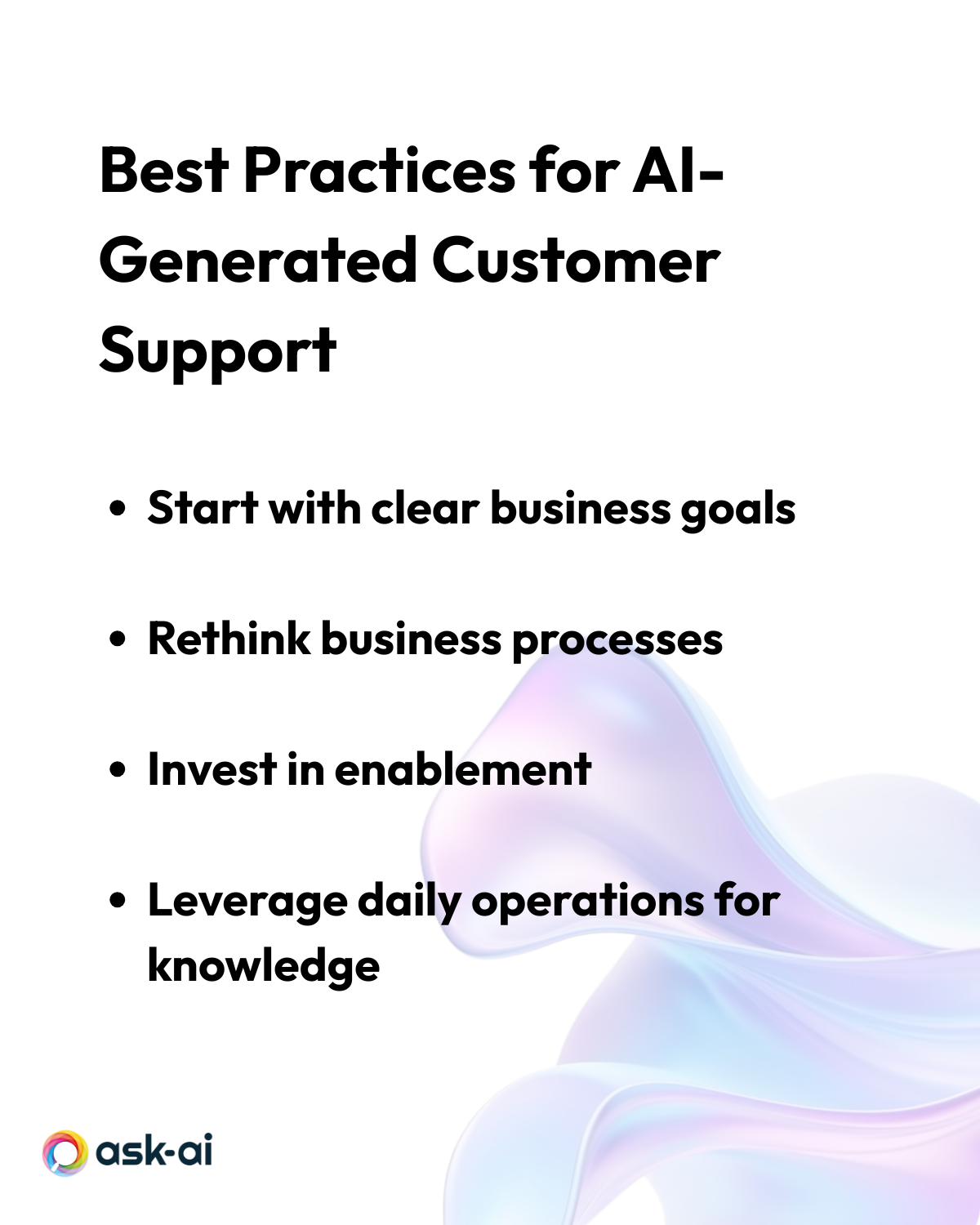
Best Practices for Companies That Use AI-Generated Customer Support
Yuval Cohen of InTeam Group Ltd. joined Soffer on-stage to share practical insights for other companies that use AI-generated customer support or are exploring how to scale with AI:
- Start with Clear Business Goals: Align AI initiatives with key support KPIs to ensure measurable value.
- Rethink Business Processes: AI isn't a plug-and-play tool—it should be embedded into daily workflows and customer journeys.
- Invest in Enablement: Train your teams, and create internal champions to support adoption across departments.
- Leverage Daily Operations for Knowledge: Let support teams contribute to the knowledge base as part of their everyday work, feeding smarter AI recommendations over time.
Looking Ahead: Extending AI to Customer-Facing Interactions
With internal efficiencies well underway, Clarivate is now exploring how to bring AI into customer-facing experiences. This next phase focuses on:
- Boosting deflection rates through smarter self-service
- Enhancing real-time support with AI-driven chat and triage
- Scaling customer support without compromising personalization
By bringing AI directly to the customer touchpoint, Clarivate aims to take their service to the next level—one where speed, accuracy, and scale go hand in hand.
Final Thoughts
Clarivate’s story is a great example of how enterprise teams are scaling customer support effectively through AI. From streamlining workflows to improving team productivity and customer experience, this transformation shows what's possible when AI is deployed with purpose and precision.
If you missed this talk at the Google Cloud AI Breakfast Panel and want to catch the full presentation on how Clarivate scaled Customer Support with AI, watch it here:
For companies looking to scale their customer support teams or explore AI customer support strategies, Clarivate’s approach offers a proven blueprint—one that blends people, process, and platforms to unlock meaningful results. Learn more about getting started with Ask-AI here.


.png)