

Key takeaways
- SaaS customer support is a revenue function, not a cost center
- Most SaaS support teams are still running reactive, ticket-driven models that don't scale
- A tiered support model only works when Tier 1 resolves 60–70%, not routes
- Support has a direct impact on Net Revenue Retention (NRR) through churn + expansion
- Product-led growth reshapes SaaS support demand in ways most teams underbuild for
- AI gives leverage to a SaaS support team, but only if it handles B2B complexity
Most SaaS companies measure support like a revenue function but still run it like a cost center.
I've watched dozens of support teams break at the exact same point. It's never the people. It's always the model.
The setup looks like this: ticketing software full of reactive queues, ticket volume treated as the primary measure of success, and zero connection to revenue.
Your team closes tickets and hits SLAs until the business starts asking different questions.
In SaaS, support is tied directly to NRR, churn, and expansion. Eventually, someone asks customer support to influence revenue outcomes, not just handle tickets.
Cost grows linearly with customer growth while Tier 2 absorbs a backlog of escalations that shouldn't exist, and engineering gets pulled in to babysit support until your leaders can't explain impact to execs in revenue terms.
Most teams respond by adding people. Cost climbs, the system never changes, and the problem compounds.
This guide covers what support looks like when it's built to scale: how the tiered support model actually works, how to connect support to NRR in a way that holds up with a CFO or CRO, how product-led growth changes demand, and how to build a support team that doesn't scale linearly with revenue.
This is where scaling technical support without adding cost starts. Support shifts from reacting to tickets to influencing outcomes upstream.
The biggest opportunity facing B2B SaaS support teams today is to move from a very reactive state (where you track tickets closed per day and resolution speed) and move to a proactive state (where you’re measured on how impactful you are at driving great customer and business outcomes).
How is SaaS customer support different from traditional support?
SaaS customer support is the function responsible for helping customers continuously derive value from a subscription product.
That sounds broad, but it covers a specific set of work: technical issue resolution, configuration and integration support, onboarding friction when someone gets stuck during setup, and ongoing product usage support once they're live.
Compare this to traditional software support.
In that model, support is post-sale. The customer buys the software, and support exists if something breaks. It's reactive by design.
In SaaS, that relationship never ends. Support is ongoing, and every interaction feeds into whether that customer renews, expands, or churns. There isn't a clean line between "sale" and "support"—it's one continuous cycle. That's why the revenue logic changes.
In SaaS, keeping a customer is more valuable than acquiring one. Acquisition costs are high, onboarding takes time, and if a customer churns early, you don't just lose revenue—you lose all the effort that went into getting them there in the first place.
Support is one of the few functions that touches the customer consistently across the entire lifecycle.
When support works well, customers get value faster, they use the product more, and they're more likely to stay and expand. When it doesn't, the opposite happens, and it shows up at renewal. Support is one of the main drivers of whether the customer relationship works over time.
Where does SaaS support usually break down?
Most SaaS support teams fail in predictable ways, and you can usually see it by looking at how tickets move through the system.
Tier 1 almost always turns into a holding queue. The focus shifts to triage and routing instead of resolution, so tickets get acknowledged quickly, maybe categorized, and then passed along. From the outside it looks efficient, but you're just moving work downstream.
Tier 2 gets overloaded with misrouted tickets, incomplete escalations, and issues that should have been resolved earlier but weren't. They're not solving problems—they're also redoing work that already happened once, which slows everything down and creates a constant backlog.
By the time something reaches Tier 3 or engineering, it's worse.
Tickets arrive without context, reproduction steps are missing or unclear, and engineers re-investigate from scratch. From engineering's perspective, support isn't handing off clean work. From the support team’s perspective, they're escalating because they don't have another option.
That's when it breaks at the leadership level. Support leaders are asked to influence NRR and customer health, but they don't have visibility into what's driving outcomes.
The system keeps generating more work, but no one can point to where the real constraint is.
The SaaS tiered support model starts with fixing how Tier 1 actually works
A blanket approach where there's only one support team with one set of SLAs is the approach that breaks more often than it helps.
In that model, every ticket is treated the same, regardless of complexity or customer context, and you expect every agent to have the same level of technical depth. Over time, that creates a gap. Volume grows, complexity increases, and the team doesn't have a clean way to separate what should be solved at the front line versus what needs deeper expertise.
That's where a tiered support model becomes necessary.

Tier 1 is the foundation—and most SaaS support teams either work or fall apart here.
Tier 1 should function as a front-line resolution and deflection layer, but more importantly, it should act as a resolution engine. In a well-designed system, Tier 1 resolves roughly 60 to 70 percent of all incoming tickets without escalation.
When that's not happening, it's almost never because the agents aren't capable. It's usually one of three things:
- Knowledge quality isn't good enough, so agents don't have reliable answers to work from.
- Tooling doesn't provide enough context, so they can't see what's happening in the customer's account.
- Information forces too much mental overhead, so even simple issues take longer than they should.
Tina Grubisa, Head of Value Consulting at Mosaic AI, nails this:
"The fastest way to improve performance in your support organization is to reduce mental gymnastics. Low-value work and rework is the unbudgeted cost center in every support organization."
The types of issues Tier 1 should handle are consistent: common product questions, onboarding friction when someone is getting set up, and basic configuration issues that don't require deep system knowledge. These are high-volume, repeatable problems that should be solved quickly at the front line.
This is where self-service and AI have the most impact.
If your knowledge base is strong and your systems can surface the right context, a large portion of these tickets never need to become tickets in the first place. And for the ones that do, Tier 1 agents should resolve them without passing them downstream.
If Tier 1 isn't resolving the majority of tickets, the problem isn't at the edge of the system—it's at the foundation.
Extending Tier 1 support with AI tooling
Once Tier 1 is set up as a real resolution layer, the next step is extending it with the right systems, including AI and self-service options.
To be clear, a great AI platform helps across all customer support tiers, but many of the typical things people think of when considering customer support AI belong in Tier 1 support, such as chatbots. In most SaaS environments, chatbots and self-service effectively become part of your front line support offering.
They show up in in-product guides, tooltips, a well-structured help center, and chat widgets that can surface answers or guide a user before they submit a ticket.
Agent assist tools also apply here, although they’re not customer-facing. Instead of agents searching manually, the assist tool pulls relevant answers, past tickets, and product context directly into the workflow in real-time as agents are responding.
With these tools in place, customers find answers on their own, tickets never get created, and the ones that do come in are easier to resolve because the agent already has context. Over time, Tier 1 behaves more like a traditional Tier 2 layer, without adding cost.
Keep in mind that if your knowledge base is weak, AI amplifies the problem. You're not solving issues faster—you're pushing bad or incomplete answers to more places, which leads to more escalations, not fewer.
When the knowledge layer is strong, you get the opposite effect: deflection improves, Tier 1 resolves more, and the system stabilizes. If you have AI that deflects 60% of tickets, and a strong Tier 1 team that resolves 60-70% of tickets, do the math.
Assume you previously had 1,000 tickets each month, and 50% of those would escalate to Tier 2 (500 tickets).
Apply this model with a more effective Tier 1 layer, and the numbers look more like this:
- AI deflects 60% of 1,000 = 400 tickets left
- Tier 1 resolves 65% of those 400 = 140 escalate
You'd go from 500 Tier 2 tickets to 140 Tier 2 tickets. Same customer demand, more effective system. AI at this layer isn't a shortcut—it's a multiplier of what you already have.
Tier 2 is where most SaaS support teams feel pressure
Tier 2 is the specialist layer.
This is where B2B technical support differences come into play: more complex work, custom account configuration issues, multi-faceted integrations, and edge cases that don't show up in standard documentation. It requires deep product knowledge, including understanding how your product behaves in real customer environments.
In a healthy B2B SaaS support team, Tier 2 is focused on that work.
And in well-run teams with strong Tier 1 and AI tooling, lower volume—even on complex tickets—often leaves time for specialists to upskill or support the business in other ways. This includes keeping the knowledge base up to date, building new AI agents, improving onboarding to decrease ramp time, and more.
But that's the ideal state. Most teams aren't there. Tier 2 gets overloaded with work that should have been resolved earlier: tickets that were misrouted, escalations that don't have enough detail, or issues that could have been solved with better knowledge at Tier 1.
That creates a compounding effect—Tier 2 slows down, backlog builds, response times increase, and more tickets get escalated because Tier 1 can't keep up. It turns into a loop.
The root cause is almost always the same: weak deflection, poor knowledge distribution, and no consistent criteria for what qualifies as an escalation.
Tier 2 overload is rarely a staffing problem. It's a signal that something earlier in the system isn't working.
Tier 3 is not a team—it's an interface with engineering
Tier 3 is often described as an escalation tier, but in most SaaS companies it's not a staffed layer in the same way. It's a process of how support interfaces with engineering.
The work that should reach this layer is narrow in scope: bugs, product failures, and issues that genuinely require changes to the codebase. That's it.
The handoff is where this usually falls apart. When a ticket reaches engineering, what does it look like?
In a well-designed system, it comes with reproduction steps, logs, clear context, and specific account details needed to understand the issue. An engineer can pick it up and move forward without re-investigating.
In a broken system, it's "customer says X is broken," and everything else has to be figured out from scratch. That's where most engineering frustration comes from. It's not the volume that’s the problem. It's the quality of the input.
This is where proactive support also makes a difference. More context captured earlier and fewer issues resolved before they escalate means less work for engineering.
Tier 3 doesn't scale based on how many engineers you have—it scales based on how clean your escalation process is, and that's something support owns.
Support and NRR is the conversation that actually lands with the business
When support gets pulled into revenue conversations, it almost always comes back to one metric: Net Revenue Retention (NRR).
NRR captures retention, expansion, and contraction in one number, so it becomes the clearest signal of whether your existing customer base is growing or shrinking over time. And once you're operating in a SaaS model, support and NRR are directly connected (whether you're measuring it or not).
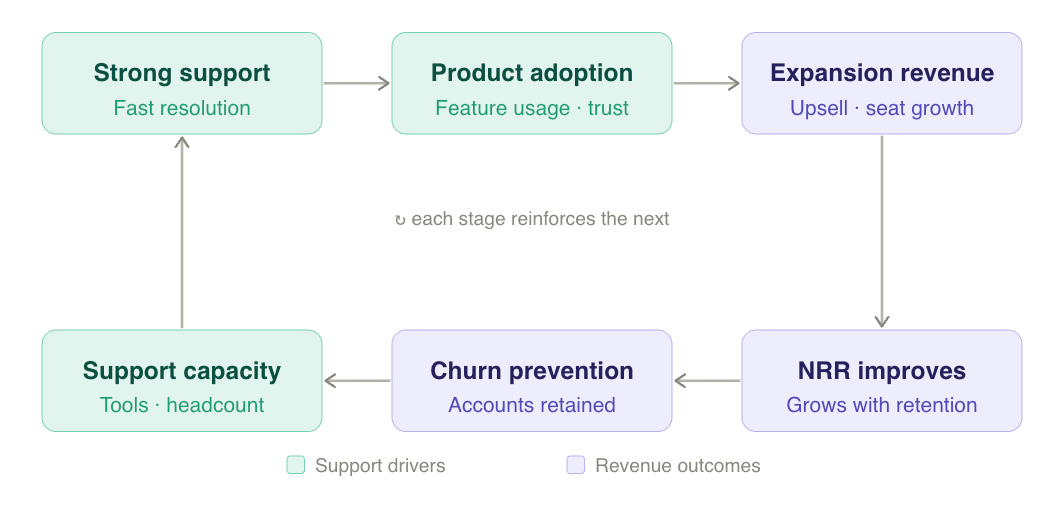
There are two places where this shows up most:
- Churn prevention efforts
Poor support creates slow response times, slow resolution, and frustrating customer experiences. And that doesn't show up immediately, but it accumulates. By the time a renewal comes around, the customer has already decided whether the product feels reliable or not.
Unresolved issues and bad escalation experiences are direct churn risks, even if they look like isolated tickets in the moment.
- Account expansion efforts
Good support does the opposite. It leads to more product usage, more feature adoption, and more trust in the system. When customers feel confident that issues will get resolved quickly and correctly, they're more willing to go deeper into the product, and that's where expansion happens.
Support isn't just protecting revenue—it's creating the conditions for growth. Most teams know this is happening, but they can't prove it. Tina Grubisa, Head of Value Consulting at Mosaic AI, puts it this way:
"If you can't show in dashboards what you've gained in revenue or time saved, you haven't proven anything."
So how do you measure this?
A few metrics that tell the story:
- Time to resolution, broken down by customer segment
- Escalation rate and how it trends over time
- Ticket volume per account over time, which often signals churn risk when it increases
- CSAT to renewal correlation, not just CSAT in isolation
With those, you're not just reporting on activity—you're showing how support performance connects to outcomes.
If you can't connect support activity to NRR in a way that shows up in your reporting, it's difficult to justify investment, even if the impact is already there.
Product-led growth changes how support demand actually shows up
Product-led growth (PLG) is a specific type of SaaS model, and it changes how support demand shows up.
In a sales-led model, the flow is predictable. You have structured onboarding, fewer accounts, and those accounts tend to be higher value and higher touch. A lot of the early friction gets handled during onboarding, so support is dealing with a narrower set of issues once the customer is live.
In a PLG model, you don't get that structure.
You have self-serve onboarding from the start, a larger base of users, and significantly lower touchpoints, but those users are still generating support demand.
Instead of onboarding tickets, you see more in-product confusion: people trying to figure out how a feature works, or how to get from one step to the next without guidance. You see more feature discovery questions, and a lot more edge cases where the product doesn't match the user's expectation or setup.
Operationally, the demand shifts. You get more volume at the lower end, more variability in user sophistication, and fewer structured interactions where you can guide the customer directly. And that changes what the support system needs to look like.
You need stronger self-service, not just a help center but something that surfaces the right answer at the right time. You need better in-product support, whether that's tooltips, guides, or contextual prompts. And you need a model that can handle multiple user types at the same time, from someone just trying the product for the first time to someone running a complex setup.
Here’s the point: PLG doesn't reduce support demand. It redistributes it.
You're not dealing with fewer customer issues. You're dealing with a wider base of smaller, more varied issues that show up earlier in the customer lifecycle.
If you're operating in a PLG SaaS model and your support system still assumes structured onboarding and high-touch engagement, you're going to feel the mismatch quickly.
Building a technical support team that scales with a flat budget
When teams start thinking about how to scale support, the instinct is to add people. That works for a while, but it’s costly.
Teams that scale best start with their structure, knowledge, and workflows—not cost. A few areas matter most:
Staffing ratios only work if Tier 1 is actually resolving customer issues
A rough ratio I’ve seen a lot is three to four Tier 1 agents for every Tier 2 specialist.
This only works if Tier 1 is doing real resolution work and escalating cleanly when needed. If Tier 1 is acting as a ticket routing layer, that ratio breaks immediately, and you end up with Tier 2 carrying work that should never have reached it.
That means your backlog builds, and the instinct is to hire more specialists instead of fixing the flow.
Knowledge management isn’t just documentation, it's critical infrastructure
Knowledge management isn't just a help center or internal docs. It's the core system everything else depends on.
If it's weak, Tier 1 struggles to resolve issues, traditional AI tools surface incomplete or incorrect answers, and escalation rates increase because agents don't have what they need.
But if knowledge management is strong, the opposite happens: Tier 1 resolves more tickets, self-service improves, and the system stabilizes because the same problems don't need to be solved over and over.
Every unnecessary escalation is a sign that knowledge was missing or inaccessible at the point of resolution. Instead of treating knowledge as something you update occasionally, it needs to be a living system that’s continually improving.
AI knowledge management is one of the best ways to do that, because AI is great at identifying knowledge gaps. It can also automatically create documentation to plug those holes. And when your customer support AI is connected to tools like your CRM, your ticketing system, your Slack workspace, and your help center, it means AI will also have the full context of what knowledge is missing.
Metrics need to reflect how SaaS businesses actually operate
Most support teams report activity, not outcomes. Traditional metrics like customer satisfaction and ticket close rate are still useful to keep an eye on, but they don't tell the full story, especially in a subscription-based model.
If you're trying to connect support to the business, you need metrics that reflect how revenue behaves:
- SLA adherence by customer segment (not just overall averages)
- Escalation rates and how they trend over time
- Ticket volume per account over time, especially when it spikes
- The relationship between support performance and renewal or expansion outcomes
With those KPIs in mind, you're not just showing how busy the team is. You're showing how support impacts the customer lifecycle.
AI is a scaling lever, not a headcount replacement
AI is one of the biggest shifts happening in support, but it's often framed the wrong way. It's not about replacing human agents; it's about increasing what each person can do.
Think about it this way: AI should give Tier 1 access to Tier 2-level context and speed.
That means surfacing account-specific answers, pulling from past tickets, documentation, tools like Slack or Salesforce, and understanding how a customer's specific configuration affects the issue they're seeing.
Agent assist tools make a big difference here because they bring that context directly into the workflow, instead of forcing agents to search across systems.
From a system perspective, what you want is a unified data layer across agent assist, self-service, knowledge, and analytics. That’s why choosing AI for technical support teams is so important—you’re building a unified, well-integrated system, not just a collection of point solutions.
How Mosaic helps: Mosaic AI creates a Customer Context Model that unifies data from your existing stack, across agent assist, self-service, knowledge, and analytics.
Scaling support isn't about adding more people faster. It's about building a system where each layer is doing its job properly, and then using AI and knowledge to extend what the team can handle without increasing headcount at the same rate as growth.
SaaS technical support is a revenue function
Support isn't a cost center in a SaaS business—it's part of the revenue system, and the teams that recognize that early are the ones that scale without breaking.
You tighten your tier structure so work is resolved at the right level, not just moved around. You connect support performance to NRR in a way that shows up in your reporting, not just intuition. You need a knowledge system that's improving over time, not a static set of documents that drift out of date. And you use AI in a way that extends your team's capability, not that adds another layer of tooling.
When those pieces come together, support stops scaling linearly with the business—it creates leverage.
Most support teams I talk to are at this inflection point—measuring support like a revenue function but still running it like a cost center. If you want to see what the shift actually looks like, book a demo with Mosaic AI.
FAQs
How is SaaS technical support different from traditional software support?
In traditional software, support is something you use after the sale. In SaaS, it's ongoing and tied to revenue. Good support increases retention and expansion—bad support shows up as churn later.
What metrics should a SaaS support team track?
Focus on metrics that connect to the business: SLA by segment, escalation rate, ticket volume per account over time, support impact on revenue retention, and time to resolution. More traditional support KPIs are useful, but aren’t usually connected to customer and business outcomes.
What is a tiered support model in SaaS?
It's how you structure your support team to resolve customer issues. Tier 1 handles high-volume issues and should resolve most tickets—around 60 to 70 percent. Tier 2 handles more complex work. Tier 3 liaises with engineering. If Tier 1 isn't resolving enough issues, the system breaks.
How does product-led growth affect technical support?
PLG shifts demand. Instead of structured onboarding, you get more in-product confusion and feature questions from a larger group of users. It doesn't reduce support demand, it redistributes it. That means you need stronger self-service and better in-product support.