













Key takeaways
- Not all B2B customers are created equal: Enterprise accounts are more complex, have a high concentration of recurring revenue, and have many stakeholders with competing priorities.
- Moving from mid-market to enterprise customer support requires a more profound structural shift than the one from B2C to B2B.
- Account-tiered service delivery is the foundation of enterprise support, and with service-level agreements clearly specifying response commitments, escalation routes, and staffing models.
- Giving support agents immediate access to resolved case history and account context, rather than building that knowledge from scratch, ensures agent ramp time doesn’t put a ceiling on growth.
- AI supports enterprise accounts throughout the ticket lifecycle by structuring context at intake, surfacing resolved cases during triage, and capturing fix data at resolution.
A support ticket lands on a Monday morning from one of your top three accounts. Two C-suite executives are copied on the thread. The service level agreement (SLA) clock is running. The support engineer assigned to the ticket doesn't know the account's configuration history—and the last person who did just gave in their notice. The customer is counting on a response in 30 minutes.
That's not a standard B2B support problem. That's an enterprise support problem, and it looks nothing like a mid-market queue (even when the ticket count is lower). I've spent years working with B2B companies at different stages of growth, and the transition from mid-market to enterprise support is tricky to get right. The teams that struggle are continuing to run a mid-market model on high-value enterprise accounts. The problem is that the mid-market model isn't designed for the commercial weight, stakeholder complexity, or knowledge demands that enterprise relationships always carry.
Most articles in this space focus on B2B customer service and how it differs from B2C. That's useful background, but it sidesteps what changes when you move up the B2B ladder from mid-market to enterprise? The answers determine whether your support model can truly scale with your most important accounts.
What is enterprise customer support?
Enterprise customer support is the function responsible for managing post-sale service relationships with high-value business accounts. Unlike mid-market support, which is optimized for ticket throughput, enterprise support is optimized for account health: Managing multi-stakeholder relationships under contractual service-level agreements (SLAs), handling complex bespoke configurations, and preserving trust across long-term service relationships that directly affect renewal.
The distinction this piece focuses on is enterprise versus mid-market, not B2B versus B2C, which is already covered in this article on what makes B2B technical support different. What matters here is what changes at the enterprise tier, and why the customer service teams that work well at mid-market stop working when account complexity and revenue concentration increase.
Mid-market versus enterprise customer support: What’s the difference?
The gap between mid-market and enterprise support includes three major structural differences:
Operating logic changes as revenue stakes increase
In mid-market support, the risk of a poor customer experience is distributed across a larger customer base. Losing one account is a setback, but it doesn’t devastate the company's bottom line. In enterprise support, a single account can represent a substantial portion of annual recurring revenue (ARR), which means every support ticket carries more commercial weight than any mid-market interactions do. That focus alters how escalation thresholds get set, how updates get written, and what counts as an acceptable resolution time.
The commercial pressure isn't abstract. According to McKinsey's B2B Pulse research, eight in ten B2B decision-makers say they'll actively look for a new vendor if their current provider doesn't deliver on performance guarantees. In enterprise support, those performance guarantees are often written directly into the contract, and resolution timelines are typically short. When your product or service underpins a customer's daily operations, each missed SLA is a data point that shows up in the renewal conversation.
Response time expectations at the enterprise level are tight. According to Zendesk's 2026 CX Trends Report, top-performing B2B SaaS companies achieve a first-response time of under 1 hour for standard email support. For critical and high-severity issues, enterprise SLA windows are even shorter. For a full breakdown on response windows and resolution targets by severity tier, see this article on B2B support SLA management.
A single account involves multiple B2B customers and stakeholders
With enterprise accounts, the "customer" isn't one person. It's a group of people with different roles, levels of technical knowledge, and definitions of a satisfactory resolution. The developer who filed the ticket wants a root cause and a reproduction case. The IT manager wants to know the security implications. The executive sponsor wants to know whether this will show up in the numbers they reported to the board.
Writing a single update that works for all of them without saying the wrong thing to the wrong audience is challenging, and that difficulty compounds with every enterprise account added to the portfolio. As my colleague Tina Grubisa, Head of Value Consulting at Mosaic AI, puts it:
"Support agents aren't operating a system—they're trying to survive an ecosystem of tickets. And that ecosystem compounds in complexity over time." — Tina Grubisa, Head of Value Consulting, Mosaic AI
Knowledge compounds as accounts age
Enterprise accounts don't just accumulate more tickets than mid-market accounts. They accumulate more institutional complexity. Configurations evolve. Integrations multiply. Incident history builds across years. The engineers who know an account best are also the most expensive and the hardest to replace when that talent leaves the company.
In mid-market support, a reasonably maintained knowledge base covers most of the workload. In enterprise support, the answer to a support ticket might live in a Slack thread from eight months ago, a configuration note buried in a previous incident, or a product detail that only one engineer on your team knows the ins and outs of (because they originally built it!). According to Salesforce's 2025 State of Service report, 58% of agents at underperforming support organizations toggle between multiple screens to find the information they need, compared with 36% at high-performing organizations. That gap widens at the enterprise level, where B2B service is more fragmented, and the cost of getting it wrong is higher.
What does a premium enterprise customer support experience look like?
Excellent customer service at the enterprise level isn't simply white-glove gestures or dedicated phone lines. It's defined by structure: A support model deliberately designed for account complexity, tiered by value, instrumented with the right metrics, and built so that leadership has early warning before a situation escalates to the executive tier.
Support delivery structured by account tier
Not every enterprise account requires the same level of service, and high-performing enterprise customer service teams don't pretend otherwise. Account tier, typically based on ARR, determines response commitments, escalation paths, and staffing models. Top-tier accounts may warrant a named support engineer or priority access to senior technical staff. Mid-tier enterprise accounts may be served through a pooled model with faster-than-standard SLA windows.
Getting this structure right means allocating resources to the accounts where a service gap would cause the most commercial damage.
Here’s a breakdown of what the support delivery structure could look like by account tier:
Executive visibility built into your support process
Enterprise support tickets regularly involve stakeholders at the director, VP, and C-suite levels. Premium customer service at this tier means leadership has early warning before an issue reaches those stakeholders, not a retrospective report after the thread has already escalated. That requires moving from weekly reporting to real-time monitoring of account sentiment, escalation rate trends by account, and ticket cadence signals that indicate a customer relationship under strain.
Salesforce's State of Service report also found that 77% of customer service representatives say their workload and the complexity of issues have both increased in the past year. At the enterprise level, that complexity is felt most acutely when each ticket involves more people, more systems, and more organizational history than the team has visibility into. Support platforms that use customer data to surface real-time account risk signals (instead of requiring leaders to find problems after the fact) make a measurable difference in whether enterprise relationships hold.
Mosaic AI continuously monitors support cases for tone, cadence, and risk signals, surfacing at-risk accounts in real time so support leaders can act before an issue reaches the executive tier.
Account health insights that go beyond ticket-level metrics
Ticket-level metrics measure a single interaction. What they won't tell you is that renewal is at risk in six months. In mid-market support, a metric like customer satisfaction (CSAT) serves a clear purpose, but at the enterprise level, account health requires a broader set of signals:
- SLA adherence by severity and account tier
- Escalation rate trends per account
- Time-to-resolution by issue type
- Repeat issue rate per account
- First-day resolution (FDR)
- Agent capacity reclaimed
Support teams that track these metrics have materially better insight into account health and a much earlier window to act before a customer question becomes a customer problem.
Why is B2B support harder to scale at the enterprise level?
Scaling enterprise support can’t simply be solved by adding more headcount. The underlying challenge runs deeper, across three structural forces that compound on one another and rarely surface clearly in a mid-market operation.
Knowledge bases can't keep up with account complexity
A knowledge base built for mid-market support is designed around repeatable patterns. Complex B2B support at the enterprise level breaks that assumption. Every significant account has a unique environment, a unique history, and a unique set of configurations. At scale, the knowledge base stops reflecting what support agents actually need to know, and agents stop trusting it. They start relying on colleagues instead, which moves the most valuable institutional knowledge out of any searchable system and into people's heads.
According to HubSpot's State of Customer Service report, 71% of service leaders say that back-and-forth between tools makes ticket resolution take longer. In enterprise support, where a single ticket may require information from a CRM, a ticketing system, a Slack thread, and a legacy configuration document, that friction compounds significantly. Support tools that automatically capture resolution data from closed tickets, including root cause, fix, environment, and version, and format it into searchable knowledge, giving agents a starting point that reflects institutional memory rather than requiring them to rebuild it each time.
Mosaic AI automatically captures resolution data from closed tickets and turns it into structured, searchable knowledge base (KB) articles available to the next agent.
Agent ramp time becomes a ceiling on growth
In mid-market support, a new hire can be handling standard work meaningfully within a few weeks. In enterprise support, full effectiveness on complex, bespoke accounts, including knowledge of the customer's configuration, integration history, and escalation preferences, can take six to 12 months. When headcount is the growth plan and that headcount won't reach full output for the better part of a year, that’s a structural problem.
At Conductor, the answer was access. By giving new support agents immediate access to resolved case history and account context rather than having them build that knowledge from scratch, the team reduced agent ramp time by 30%. The institutional knowledge moved from individuals to the system, which meant the system could carry it forward regardless of team changes.
Mosaic AI’s assistance tools give new agents instant access to similar resolved cases, account history, and suggested next steps directly inside the ticket, without needing to switch tools.
Escalations slow down the entire organization
Each escalation to a senior engineer or the engineering team carries a cost that goes beyond the original ticket. It interrupts higher-order work, creates coordination overhead, and produces a queue of demand behind it. At the enterprise level, where escalations involve more stakeholders and more communication per ticket, this compounds across the queue in ways that don't appear in average handle time metrics.
Getting ahead of escalations, rather than managing them after the fact, frees up capacity across the entire organization.
How does AI change what's possible in enterprise support?
Most AI tools available to B2B service teams today were designed for mid-market volume patterns: High frequency, lower complexity, and repeatable resolutions. They deflect more common questions and can automatically suggest knowledge base articles. That model doesn't transfer to enterprise support, where the problem isn’t volume. It's the account-specific context, the long-tail technical complexity, and the institutional history that determine whether a resolution is actually correct. It's a challenge our founder and CEO, Alon Talmor, addresses directly in his open letter on why we built Mosaic AI for enterprise B2B support.
As my colleague Jamie Bergmann, Director of Solutions Engineering at Mosaic AI, puts it:
"The knowledge is more fragmented, the products and services your customers rely on are more complex, and the landscape is constantly shifting." — Jamie Bergmann, Director of Solutions Engineering, Mosaic AI
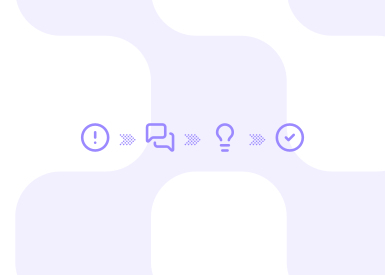
AI built for enterprise complexity works inside the ticket lifecycle, at each stage where context loss creates the most friction.
At intake: Structured account context from the first message
Enterprise tickets regularly arrive without the diagnostic information a support agent needs to start working. Version, environment, logs, and configuration details are either missing or scattered across systems. AI that structures intake captures what's needed and matches it against account history before a human touches the ticket, which changes the starting position for every step that follows. A ticket that arrives structured and context-complete is easier to triage, quicker to route, and faster to resolve.
Mosaic AI captures structured diagnostic data at the point of ticket creation and routes a context-complete ticket to the right agent from the start.
During triage: Surfacing what's been solved before across the account
The most expensive thing a support engineer can do is investigate a problem that's already been solved. During triage, AI that retrieves similar resolved cases across the account's specific history gives agents a starting point built on institutional knowledge rather than requiring them to reconstruct it. At enterprise scale, where each account carries years of issue and resolution history, this is where the biggest gains in time-to-resolution are available.
Mosaic AI analyzes the live ticket in full and matches it against resolved cases across the account along with the broader customer base, surfacing the most relevant resolutions and recommended next steps directly inside the agent's workflow.
At resolution: Automated capture that builds the next agent's starting point
The knowledge problem in enterprise support isn't only retrieval. When a complex enterprise ticket is resolved, the fix often exists only in the engineer's head or is buried in a long thread. AI that automatically captures the root cause, fix, environment, and key artifacts at ticket close, and structures that data into something searchable, means every resolution improves the starting point for the next agent who encounters a similar issue.
At Rapid7, that kind of systematic knowledge capture was deployed across every frontline team simultaneously, thanks to Mosaic AI. Each resolution added to a shared institutional knowledge layer that made the next resolution faster across the entire support organization, not just within individual teams.
Mosaic AI’s automated resolution capture extracts structured fix data at ticket close and feeds it back into the knowledge layer, without requiring agents to write anything up manually.
5 B2B customer service best practices for enterprise support teams
The B2B customer service best practices that work at mid-market optimize for speed and volume. The ones that matter at enterprise optimize for account depth: Building the systems, habits, and tooling that make it possible to meet customer needs consistently across complex, high-value B2B clients without burning through institutional knowledge every time the team grows or changes. Here are five practices to try below:
1. Treat every closed ticket as a knowledge asset
Most enterprise support teams are good at firefighting, but not so good at preserving what they learn. Every resolved ticket contains information that could help the next support agent handle a similar issue faster, but only if that information gets captured in a structured, searchable format. Building knowledge capture into the ticket close process, rather than treating it as optional documentation, is one of the highest-leverage habits an enterprise support team can build.
Structured resolution data also creates the building blocks for scaling enterprise self-service. When fixes are captured in a consistent format, they can be proactively surfaced to customers as new knowledge base articles, helping to deflect the next ticket.
2. Measure the support metrics that predict renewal
Interaction-only scores alone won't surface a renewal at risk. The metrics that give enterprise teams early warning are the ones that reflect account health over time, such as:
- Escalation rate trends per account
- Repeat issue rate
- SLA adherence by severity and account tier
- First-day resolution (FDR)
- Agent capacity reclaimed through AI-assisted workflows
Teams that track these metrics have better conversations with their account and customer success teams at quarterly business reviews—and a much earlier window to intervene when an enterprise relationship shows signs of strain.
3. Give agents account context before the first response
The gap between a senior enterprise support engineer and a new hire isn't primarily knowledge. It's access to context. The senior engineer knows the account's history. The new hire has to reconstruct it from scratch on every ticket. AI that surfaces the right account context the moment a ticket opens, including configuration history, past tickets, integration details, and similar resolutions, closes that gap without requiring the new hire to spend months building it organically.
4. Design escalation paths that don't rely on one person knowing everything
Escalation paths that depend on undocumented knowledge, like knowing which engineer to ping or which Slack channel has the relevant thread, don’t scale well. When the person who holds that knowledge is unavailable, the path stalls. Documented, structured escalation flows with diagnostic requirements at each handoff make enterprise support more resilient and less dependent on any single individual's institutional memory. Personalized support for enterprise customers requires a system that carries the context, not a person.
5. Close the loop between support data and the rest of the account team
Enterprise support generates signals that the rest of the account team needs to act on: Repeat issues that indicate a product gap, sentiment trends that suggest a renewal conversation is needed, and configuration patterns the customer success team should know about. When support operates in a silo, those signals disappear into the queue. Closing the loop between support data and the sales, customer success, and product teams turns support from a reactive cost center into a proactive contributor to customer retention across every stage of the customer journey.
The support model that scales with your most important accounts
What separates enterprise support operations that scale from those that stall is whether the model was built for account depth or ticket volume. Ticket-volume thinking produces mid-market tooling, mid-market metrics, and mid-market staffing assumptions applied to accounts that don't fit the model. Account-depth thinking produces service relationships designed to hold under commercial pressure, institutional knowledge that survives personnel changes, and AI that reduces friction at every stage of the ticket lifecycle.
The teams I see getting this right have made these operational shifts:
- Tier service delivery by account value
- Track account health metrics rather than interaction-level satisfaction scores
- Design escalation routes that don't depend on any one person
- Treat every resolved ticket as a knowledge contribution
Excellent B2B customer service at the enterprise level is one of the most durable sources of customer retention available to your business. It doesn't just resolve tickets. It builds the kind of trust that shows up in renewal conversations, in the accounts that stay long enough to become your best case studies.
Frequently asked questions
How do you build a business case for investing in enterprise customer support infrastructure?
When building your business case, start with the revenue at risk. Map your top accounts by annual recurring revenue (ARR) and model, for example, what a 5% or 10% increase in churn among that group would cost the business annually. Then compare that number against the cost of the infrastructure investment. Most support teams find the math is compelling once they stop treating support as a cost center and start treating it as a retention function. Support data, particularly escalation rate trends and repeat issue rates per account, gives you the evidence to make that case to leadership and the buying committee.
What's the difference between a dedicated and a pooled support model for enterprise accounts?
A dedicated support model assigns a named engineer or small team to a specific account. That support engineer knows the customer's environment, history, and preferences. In contrast, a pooled model routes tickets to whoever is available and provides shared access to account context.
Dedicated models work best for the highest-value accounts where relationship continuity and trust directly affect renewal. Pooled models work well when account volume and team size make dedicated assignment impractical. Many enterprise support teams use a blended approach: dedicated coverage for the top tier and pooled coverage for the rest.
When should an enterprise support team consider a named support engineer model?
Consider a named support engineer when the cost of a poor experience at a specific enterprise account is high enough to justify the dedicated headcount. For example, if a single account represents more than 5% or 10% of total annual recurring revenue (ARR), then it’s safe to say that the account's technical complexity requires sustained institutional knowledge to resolve issues successfully. After all, relationship continuity and trust are meaningful factors during renewal.
How does Mosaic AI help enterprise support teams manage high-value accounts without adding headcount?
Mosaic AI gives every support agent on your team the same starting advantage as your most experienced engineer: Instant access to relevant context the moment a ticket opens. For example, when a support agent receives a ticket from a high-value account, Mosaic AI surfaces configuration history, previously resolved cases, and similar issues across the customer base, reducing time to resolution regardless of how long the agent has been on the team. The same capability accelerates ramp time for new hires, reduces escalation volume by giving Tier 1 agents better starting context, and captures every resolution as structured knowledge that compounds over time.