Key takeaways
- Self-service and knowledge management are one system, not two separate tools: AI self-service in front, with continuously updated knowledge behind it.
- Self-service without fresh knowledge plateaus fast. Gartner found only 14% of customer service issues are fully resolved in self-service, even though 73% of customers try it.
- Mosaic AI’s Self-Service and Knowledge work hand in hand, automatically converting solved support cases into review-ready knowledge articles that keep self-service up to date.
- The flywheel: self-service surfaces the gaps, reps resolve them, resolutions become reviewed articles, and articles feed back into self-service. Every turn deflects more.
Most support organizations buy self-service and knowledge management as separate projects, run by separate owners, on separate timelines. Then they wonder why deflection plateaus after the first quarter. The reason is structural: self-service only works as well as the knowledge behind it, so they need to operate as a single system. Self-service is the engine, knowledge is the fuel, and neither performs without the other.
That's why we built our Self-Service and Knowledge modules to launch together. This post breaks them both down and explains the loop that connects them.
What is a self-service knowledge base?
A self-service knowledge base is a knowledge base built and maintained to power AI-driven customer self-service, rather than to be browsed by humans. It combines two functions in one loop: an AI front end that troubleshoots customer issues across your help center, portal, product, and case submission flow, and a knowledge layer that continuously identifies what's missing and fills the gaps from real case resolutions.
It is not a traditional help center with a search bar, and it is not a chatbot pointed at stale documentation. Both of those fail for the same reason: the knowledge behind them stops matching the product in front of them.
Why do self-service tools plateau without knowledge?
The data on standalone self-service is sobering. According to 2024 survey data from Gartner, 73% of customers use self-service at some point in their journey, but only 14% of issues are fully resolved there. Nearly half of customers who started in self-service said the company didn't understand what they were trying to do. The intent is there. The answers aren't.
Customers expect the AI to know everything about your product
The moment you put AI in front of customers, expectations change. Nobody grades an AI on effort. A blank or wrong answer reads as the company not knowing its own product. And every unanswered question adds another small dent in trust. Your self-service is only as good as the knowledge behind the AI.
"Customers would expect the AI to know everything about your product... And if you don't feed your self-service AI with the right kind of knowledge, there's no way for it to know." — A lon Talmor, CEO & Founder, Mosaic AI
Help centers age faster than products ship
In technical support environments, every release creates new features, new failure modes, and new questions with no documented answer. Support teams see those questions arrive as tickets, and many of them are answerable: not bugs, not technical failures, just new ways of doing things that never made it into the help center. Your team can't out-document every release by hand, and the gap between what customers ask and what the knowledge base covers widens with each release.
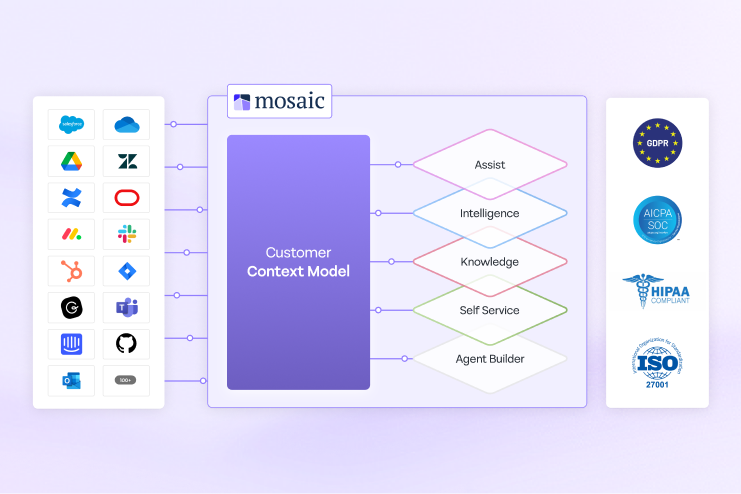
How Mosaic helps: Mosaic AI prevents the plateau by running every module on one shared context layer—the Customer Context Model. Pulling from the tools you already use, it identifies recurring knowledge gaps, drafts review-ready articles from solved support cases, and keeps the AI in front and the knowledge behind it in sync with every release.
The best documentation starts as a support case
Every day, support engineers solve technical questions that have never been documented before. They investigate logs, compare similar cases, gather customer context, and work through the problem until they find the answer. By the time the case is resolved, someone has already written the first version of the documentation, it just happens to live inside a case.
The challenge is that most organizations stop there. The customer gets their answer, the case is closed, and all of that expertise stays buried in case history instead of becoming knowledge that helps the next customer.
How Mosaic helps: Mosaic AI Assist gives support engineers the same customer, product, and support context that powers the rest of the platform, helping them investigate technical issues faster with grounded, relevant information. Because Assist runs on the same Customer Context Model as Self-Service and Knowledge, every high-quality resolution becomes the foundation for better documentation and better self-service over time.
How the flywheel works: The 5 steps of the loop
The key to overcoming the plateau is closing the gap between the two tools.
Self-Service knows exactly which questions customers couldn’t resolve on their own because they became support cases.. Support resolves those same questions every day. But in most organizations, nothing carries what support learns back to self-service, so the gap reopens with every release. Close it, and the two stop being separate projects. Every question Self-Service can't answer becomes the next one it can, and the system starts improving itself.
That's the flywheel— a loop that turns every unanswered question into the answer for the next customer.
There are 5 steps that complete the flywheel.

1. A customer starts in self-service
The AI investigates the issue using your documentation, product context, and the customer's environment. If the answer exists, the case never happens.
2. An unanswered question becomes a case with context
When self-service can't resolve the issue, the full conversation and everything already tried carries into the case. The rep starts where the customer left off, not from scratch.
3. A rep resolves it with Assist
The rep uses Assist, Mosaic AI’s agent-assist module, to pull together the scattered context and analyze technical artifacts (past cases, engineering threads, internal docs, logs, and attachments) that a rep would otherwise have to gather manually.
4. The resolution becomes a reviewed article
Knowledge detects that this question keeps arriving without a documented answer, drafts an article from the real resolution, and routes it to the right expert. A human approves before anything is published.
5. The article feeds back into self-service
The next customer with the same issue gets the answer instantly, and no case is created. The loop turns again.
"You can clearly see this knowledge flywheel working where someone starts in self-service... they then close that case that then gets turned into knowledge, which a human approves, which gets fed back into self-service." — Ben Nachmani, Head of Partnerships, Mosaic AI
What compounds when the loop runs
A flywheel is only interesting if each turn makes the next one easier. Four things compound:
- Deflection climbs. Every published article expands what self-service can resolve. Public Mosaic data shows Self-Service resolves up to 30% of tickets automatically, and coverage grows with every loop.
- The documentation backlog shrinks itself. Knowledge gap analysis prioritizes articles by real case volume, so effort goes where tickets actually come from. This is the same capture-as-you-solve principle behind knowledge-centered service, which the Consortium for Service Innovation credits with 25 to 50% faster resolution times in early adoption. The flywheel automates it.
- Reps see fewer repeats. The questions that used to arrive weekly get answered upstream, which changes the case mix reaching your team toward work that actually needs human expertise.
- Measurement gets cleaner. Because the loop is closed, you can track a specific gap from detection to published article to reduced ticket volume on that exact topic.
"...that's why we find that methodology really, really helpful when it comes to marrying knowledge with self-service." — Alon Talmor, CEO & Founder, Mosaic AI
Self-Service and Knowledge go hand in hand
We could have shipped these as two announcements. We didn't because neither module's promise survives alone. Self-service that can't learn stalls at whatever your help center covered on day one. Knowledge automation without a self-service channel produces articles nobody consumes.
Mosaic Self-Service resolves technical issues wherever customers seek help, and continuously improves by automatically making newly published Mosaic Knowledge available. Knowledge watches resolved cases for recurring gaps and drafts review-ready articles from real resolutions. Both run on the same Customer Context Model, so every interaction strengthens the next one.
How Mosaic helps: deflection plateaus because knowledge goes stale. Mosaic AI closes the loop automatically: Self-Service surfaces the gaps, Knowledge fills them with human-approved articles, and newly published knowledge powers self-service without a migration or a documentation sprint.
Related reading:
- Guide to customer self-service for technical support
- AI knowledge base foundations
- An honest breakdown of ticket deflection
- Knowledge gap analysis to see how gaps are found
The loop is the launch
Self-service and knowledge management fail as separate projects and compound as one system. If your deflection curve flattened months ago, the problem probably isn't the AI in front. It's the knowledge behind it, and the missing loop between the two. Book a demo to see the flywheel run on your own cases.
Frequently asked questions
How does a knowledge base improve ticket deflection?
Deflection is capped by knowledge coverage: an AI can only resolve what's documented. A knowledge base that closes gaps from real resolved cases expands what self-service can answer, which raises deflection over time instead of plateauing.
What is the knowledge flywheel in customer support?
The knowledge flywheel is the loop where self-service surfaces unanswered questions, reps resolve them, resolutions become human-approved articles, and articles feed back into self-service. Each turn of the loop increases what can be resolved without a case.
How do you keep AI self-service up to date after product releases?
The key is connecting self-service to the rest of your support operation. Every product release generates new customer questions, and support cases are where those answers are discovered first. Turning recurring case resolutions into reviewed knowledge helps keep self-service aligned with the product as it evolves.
Should support teams write documentation manually?
Manual documentation still matters, but it can’t keep pace with modern software. New releases and customer questions emerge faster than most teams can update their knowledge base, which is why many organizations now use resolved support cases to draft new content for expert review instead of starting every article from scratch.