Key takeaways
Alon Talmor didn't stumble into enterprise AI. He spent years studying how machines reason, specifically how AI can answer complex questions from fragmented, imperfect information, before building a company that does exactly that, at scale, for some of the world's most sophisticated B2B support teams.
Today, Alon is the CEO of Mosaic AI (formerly Ask-AI), the AI platform for B2B customer support. He's a two-time founder, a published NLP researcher, and one of a small number of people who bet early on the intersection of large language models and enterprise knowledge management.
Academic roots: NLP, reasoning, and the question of what AI can understand
Alon's interest in artificial intelligence started where most serious AI work starts: with hard questions about what machines can actually understand.
He completed a Master's degree in Brain Research before moving into computational linguistics and natural language processing. His PhD focused on reasoning for question answering (QA); the challenge of building AI systems that don't just retrieve information, but reason through it to form accurate answers.
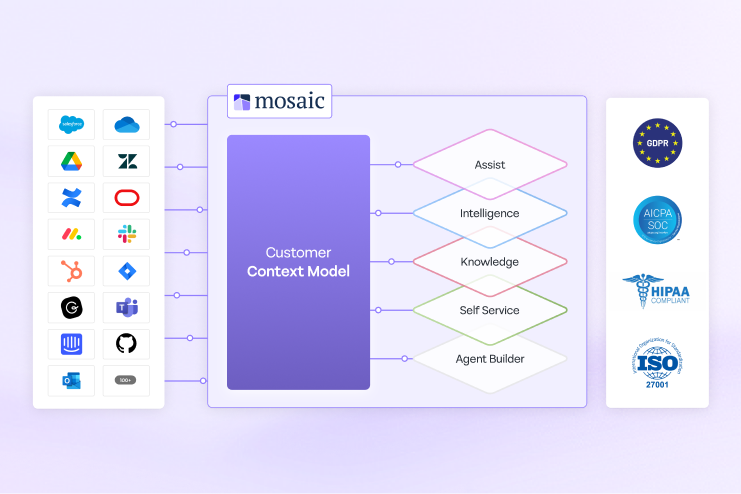
This wasn't a generic AI track. Reasoning for QA is difficult, nuanced work: teaching models to synthesize evidence from multiple sources, handle ambiguity, and know when they don't know something. It's precisely the capability that makes Mosaic AI useful in live support environments, where a single ticket might require pulling from a Confluence article, a Salesforce case record, a Slack thread, and a knowledge base article simultaneously.
During his PhD, Alon also served as a part-time research scientist at the Allen Institute for AI (AI2) from February 2019 to May 2021. AI2 is one of the most respected independent AI research labs in the world. Working there deepened Alon's exposure to NLP advances and the capabilities then emerging in large language models.
The academic grounding shows up in how Mosaic is built. Alon's position: building trustworthy enterprise AI requires the same rigor as academic research.
From research to enterprise: early career
Before founding his first company, Alon moved through a series of enterprise technology roles: Check Point Software, Tehila, and NuConomy (later acquired by LivePerson). Each stop added depth in enterprise software, analytics, and the practical challenges of deploying AI in complex organizational environments.
Alon was Chief Data Scientist of Data.com at Salesforce, a position he held after Salesforce acquired his first startup, BlueTail. This experience gave him rare insight into how enterprise software is built, sold, and adopted at scale. It also showed him the fundamental challenge Mosaic would later address: enterprise knowledge is fragmented across disconnected systems, and no individual tool can synthesize it into actionable intelligence.
Alon's founding philosophy reflects this insight: don't optimize for making employees faster. Optimize for delivering value to customers. This is the "faster horses vs. a car" principle: the question isn't how to make knowledge workers quicker at their current job, but how to transform what the job fundamentally is by giving them the context and intelligence they need to become strategic partners to the business.
BlueTail and the first startup
BlueTail was Alon's first company, a data intelligence startup that was acquired by Salesforce. Alon went from founding a company to working inside one of the world's largest enterprise software organizations.
At Salesforce, he saw how enterprise teams actually consume data, struggle with fragmentation, and fail to extract insight from the tools they already have. It planted the seed for what would become Ask-AI, and eventually Mosaic AI.
When Alon talks about the problem Mosaic AI solves, he often comes back to a simple observation: enterprise organizations have enormous amounts of knowledge trapped in their tools. The bottleneck isn't information, but rather retrieval, synthesis, and activation.
Founding Ask-AI: betting on NLP before the GPT era
Alon founded Ask-AI in 2020, before GPT-3 became widely accessible and long before ChatGPT made AI a household name.
The founding thesis was deceptively simple: enterprise knowledge is fragmented across tools (Slack, Salesforce, Confluence, Zendesk, Google Drive), and when someone needs an answer (a support agent handling a ticket, an account manager before a call) they waste enormous amounts of time hunting for it manually. AI could change that. A model trained on an organization's own data and documents could surface the right answer, in context, in seconds.
Alon had anticipated the direction AI was heading, though even he was surprised by the pace of what came next.
The early Ask-AI product was an enterprise knowledge assistant. Ask a question, get an answer sourced from your company's connected tools. It was narrower than what Mosaic AI is today, but the core insight was right: enterprise teams needed AI that understood their specific knowledge, not generic AI trained on the internet.
Building Mosaic AI: the bigger vision
In January 2026, Ask-AI officially rebranded to Mosaic AI.
Ask-AI had grown beyond a knowledge assistant into a full platform for B2B customer support and CX intelligence: AI Assist for agents, Self-Service for customers, Intelligence for leadership, and Workflow Automation for ops teams.
The rebrand to Mosaic AI reflects the platform's broader mandate. A mosaic is assembled from many individual pieces. That's what the product does: it pulls together fragmented knowledge from across an organization's stack and assembles it into a coherent, actionable picture for support teams.
Alon's philosophy is straightforward: Mosaic AI is built to empower support teams, not replace them. The platform is designed to make support teams faster, not irrelevant. The Intelligence layer, which surfaces churn signals, sentiment shifts, and product feedback, is designed for support leaders. Not to automate them away, but to give them visibility that was previously impossible.
The parent company remains Ask-AI Technologies Inc. The team that built Ask-AI built Mosaic AI. The customers who trusted Ask-AI carried over without disruption.
What Alon believes about AI for support
B2B support is harder than B2C support. Enterprise clients have multi-product environments, complex integrations, high-stakes relationships, and support tickets that can't be resolved with a single FAQ article. The stakes of a wrong answer (a misinformed customer, a missed churn signal, a failed escalation) are higher than in consumer contexts.
Alon's thesis is that general-purpose AI isn't sufficient for this environment. What's needed is AI that:
- Understands the full customer context (account history, product usage, prior tickets, sentiment trajectory)
- Reasons across multiple knowledge sources simultaneously (Confluence, Salesforce, Zendesk, Slack)
- Knows when to escalate and when to resolve
- Gives support leaders visibility into patterns, not just individual ticket outcomes
This is what shaped the Customer Context Model, Mosaic AI's proprietary data enrichment layer that consolidates customer signals across systems before any AI answer is generated.
It's also why Mosaic AI meets enterprise security requirements: SOC 2 compliance, data isolation, no training on customer data. In high-stakes B2B environments, trust isn't optional.
The team Alon built carries this philosophy forward. The platform's focus is on moving support from reactive ticket handling toward proactive customer outcomes, and on reducing the low-value search-and-retrieval work that currently consumes most of an agent's day. This is the operational translation of Alon's founding thesis into product language.
Frequently asked questions
Is Alon Talmor the CEO of Mosaic AI?
Yes. Alon Talmor is the CEO of Mosaic AI, the company formerly known as Ask-AI. He co-founded the company and continues to lead it.
When was Mosaic AI founded?
Ask-AI was founded in 2022. It rebranded to Mosaic AI in January 2026.
Where is Mosaic AI headquartered?
Mosaic AI is headquartered in New York, with teams in Tel Aviv and remote locations globally.
Has Mosaic AI raised funding?
Yes. Mosaic AI (formerly Ask-AI) has raised funding, including a $20M round covered publicly via the BUILDERS podcast. The company remains independent; it has not been acquired.
What problem was Mosaic AI created to solve?
Enterprise knowledge is fragmented across dozens of tools. Support agents, account managers, and CX teams waste hours searching for answers that exist somewhere in the company, just not at their fingertips. Mosaic AI solves this by building a unified AI layer on top of a company's existing stack.
What companies use Mosaic AI?
Mosaic AI serves B2B SaaS companies including Rapid7, monday.com, Conductor, and others in industries where technical support complexity and enterprise relationships demand more than generic AI tools. Customers report results that reflect Alon's thesis in action: significant MTTR reductions in compliance tech, knowledge article creation time dropping from about an hour to five minutes in EHS/compliance, and record-low case volumes in HR tech.
Ready to see Mosaic AI in action?
Book a demo or learn more about the platform.