Key takeaways
If you're looking for Ask-AI, you've found us. We rebranded to Mosaic AI in January 2026. Same team. Same product. Same mission, just a bigger one.
This page answers the questions we know you have.
Why did Ask-AI rebrand to Mosaic AI?
Ask-AI started as an enterprise knowledge assistant: ask a question, get an answer sourced from your company's connected tools. It worked well. Customers loved it.
But over time, the product grew well beyond that original scope. Ask-AI became a full platform for B2B support and CX intelligence: an AI copilot for agents, a self-service layer for customers, an intelligence module for support leaders, and a workflow automation engine for ops teams. The name "Ask-AI" no longer described what the product actually was.
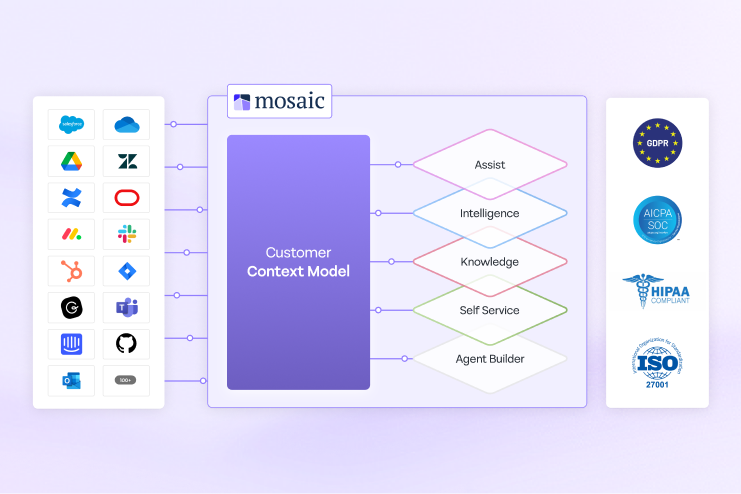
The name Mosaic AI reflects the platform's actual logic: a mosaic is assembled from many individual pieces. That's what Mosaic AI does: it pulls together fragmented knowledge from Zendesk, Salesforce, Confluence, Slack, and dozens of other tools, and assembles it into a coherent, actionable picture for support teams.
Why this matters: Founder Alon Talmor frames the rebrand around a simple principle: enterprises shouldn't optimize for making employees faster, they should optimize for delivering value to customers. The original Ask-AI product focused on answering questions faster. Mosaic AI shifts the platform's philosophy to answering the questions that actually matter to the business: Which customers are at risk? Which product gaps drive support tickets? Where is knowledge missing?
The Mosaic AI name carries that expanded mission. Ask-AI described a feature; Mosaic AI describes a platform.
The rebrand wasn't a pivot. It was a scope statement. The mission of empowering B2B support teams with AI that understands their business stayed exactly the same. Alon Talmor, the company's founder and CEO, has described the rebrand as reflecting "where the product has already gone and where we're taking it next."
What was Mosaic AI originally called? Ask-AI. And before the ask-AI product was named, the parent company was already called Ask-AI Technologies Inc., which remains the legal entity name.
What stayed the same
The team. The same people who built Ask-AI built Mosaic AI. No one left because of the rebrand.
The product. Every feature that existed in Ask-AI continues in Mosaic AI. The AI Assist that agents used, the integrations with Zendesk and Salesforce, the Confluence and Slack connectors; all of it carried forward. The rebrand added scope; it didn't remove anything.
The parent company. Ask-AI Technologies Inc. remains the legal entity. Mosaic AI is the product and brand name.
Your account, your data, your integrations. If you were an Ask-AI customer, nothing changed in your account. Your data stayed in place. Your integrations kept running. Your help center links redirected. You didn't have to do anything.
The reception from teams experiencing the expanded platform reflects what carried over, as teams consistently report that the expanded platform delivers on what Ask-AI promised.
What's new under the Mosaic AI name
The rebrand to Mosaic AI coincided with a broader platform expansion. What's new:
Expanded product portfolio (full overview):
- AI Assist: Agent copilot with cross-system knowledge: ticket summaries, AI-suggested replies, answers from across all your connected knowledge sources
- Self-Service: AI agent that deflects inbound customer queries before they reach your support team
- Intelligence: The Intelligence layer is Mosaic's differentiator. While most AI support tools focus on ticket deflection, Intelligence surfaces the patterns that drive business outcomes: which customers trend toward churn, which features generate recurring friction, where your knowledge base has gaps. The system doesn't just answer questions; it brings alerts and insights to you proactively.
- Workflows: No-code automation builder for routing, escalation, and cross-system actions
New branding, new name, new URL: The product is now Mosaic AI at getmosaic.ai.
Broader integrations: The Mosaic platform now connects to 50+ systems, expanding from the core helpdesk and knowledge tool integrations Ask-AI originally launched with.
Help center update
The Ask-AI help center was previously located at ask-ai.zendesk.com/hc/en-us. It is migrating to help.getmosaic.ai. Existing links redirect automatically, so nothing breaks if you've bookmarked old URLs.
If you have trouble accessing help documentation, contact the Mosaic support team directly.
Frequently asked questions
Was Ask-AI acquired? Is this a rebrand after an acquisition?
No. Mosaic AI rebranded independently. The company has not been acquired. Ask-AI Technologies Inc. remains an independent company, and Alon Talmor remains CEO.
Do I need to do anything as an existing customer?
No. Your account, integrations, and data carried over automatically. You may notice new features and a refreshed interface, but your existing setup is intact.
When was Mosaic AI founded?
The company was founded as Ask-AI around 2020–2021. It officially rebranded to Mosaic AI in January 2026.
What problem was Mosaic AI created to solve?
Enterprise knowledge is fragmented across dozens of tools: Zendesk, Salesforce, Confluence, Slack, Google Drive. When a support agent needs to answer a complex question, they shouldn't have to hunt across six tabs to find it. Mosaic AI was built to unify that knowledge and surface it where agents work. The broader mission: "We are in the business of helping customer support and GTM teams." This is fundamentally about empowering people with AI, surfacing the context they need to make better decisions and move faster, not replacing them.
Is Alon Talmor the CEO of Mosaic AI?
Yes. Alon Talmor, who founded Ask-AI, is the CEO of Mosaic AI. He's an NLP researcher (PhD from Tel Aviv University) and previously founded BlueTail, which was acquired by Salesforce.
Has Mosaic AI raised funding?
Yes. Ask-AI raised $20M in a round that was covered publicly. The company has not been acquired and remains independent. No additional funding announcements are confirmed as of the date of this page.
Was Mosaic AI previously called Ask-AI?
Yes. Ask-AI officially became Mosaic AI in January 2026. The rebrand reflects the platform's expanded scope from a knowledge assistant to a full B2B support and CX intelligence platform.
What companies use Mosaic AI?
Mosaic AI serves B2B SaaS companies including Rapid7, monday.com, Conductor, and others. Customers are typically mid-market to enterprise, with complex multi-product support environments.
Ready to explore Mosaic AI?