















Key takeaways
- B2C and B2B customer support operate with fundamentally different goals:B2C optimizes for speed, deflection, and efficiency, while B2B prioritizes relationships, accuracy, and lifetime value.
- B2B customer relationships involve multiple stakeholders(decision-makers, admins, end users, security teams, finance), requiring account-centric views and context-aware support—capabilities most B2C platforms lack entirely.
- B2C support tools fall short for B2B teams in critical areas:user-centric (not account-centric) architecture, shallow integrations, inability to prioritize by account value, and chatbot-first experiences that frustrate high-value customers.
- Successful B2B AI implementation requires purpose-built platformswith deep integrations across your tech stack, intelligent escalation based on account risk and value, and security and compliance features that meet enterprise standards.
- B2B support teams need AI that enhances relationships rather than replacing themachieving 30–50%+ deflection on simple queries, while enabling agents with context, knowledge, and automation for more complex, high-value interactions.
For B2C companies with massive volumes of repetitive, low-complexity questions (like ecommerce), it’s a pitch that actually could pan out. When most of your support tickets are simple questions, order updates, returns, and other highly repeatable flows, even simple AI and automation efforts can deliver big ROI fast.
But in B2B customer service? No way.
B2B customer experiences are fundamentally different. Ticket volumes are lower. Questions are more complex. Customer relationships are more valuable. When a customer is paying five- or six-figures annually for your product or service, their expectations are profoundly different.
Using a tool meant for B2C support in a B2B scenario is like using a sledgehammer to hang a picture frame: you might get the nail in the wall, but you’ll cause a whole bunch of collateral damage.
This guide breaks down what actually works for B2B customer support teams, how to evaluate vendors built for your type of business, and what B2B companies need to succeed with AI.
The fundamental differences: B2C vs B2B support
I recently took an Uber from the airport back home. The driver chose a longer route than necessary, and I was hit with an unexpected extra charge, which I only noticed once I was home.
So I contacted Uber support, explained what happened, and—because this is a common, well-understood scenario—the AI simply compared the recommended route with the actual one and instantly issued a refund. No human support agents were involved.
It was fast, low-context, transactional, and I was perfectly happy with it.
Uber receives hundreds (or thousands) of these requests every day. These high-volume, repeatable patterns are the type of requests where basic AI thrives. And when the overcharge is only a few dollars, it’s far more cost-effective to automate the request than to pay a human rep to manually review the case.
If the AI makes a wrong decision? Not ideal, of course, but with nearly 200 million monthly active users, losing a few riders to a poor automated decision won’t materially impact Uber’s business.
It’s a perfect example of the fundamental reality of B2C support: because everything is transactional and relatively low dollar amounts, the support operation is built on optimizing for speed and low costs per ticket.
Not trust, not retention, and not deep customer relationships.
It’s hard to overstate how different B2B customer service is. There are two helpful lenses to consider when examining the difference between B2C and B2B customer services:
Business model difference
In many B2B companies, the top 100 customers may contribute 50% or more of total revenue. Average contract values may be in the millions. Losing even one large account can have major financial consequences on a company.
Relationships with B2B accounts aren’t just one-to-one; they typically involve multiple stakeholders with various levels of knowledge and involvement with your product. For instance, you might have:
- A VP or COO who function as the decision-makers, approving budget and signing the contract
- A manager who is the admin for the tool, oversees usage, and is your product champion
- A large number of end users actually using the product each week
On top of that, you’re also probably dealing with security and compliance teams, a finance leader who wants proven ROI, and other stakeholders.
If you want to retain that customer as a B2B company, you need to architect a system that enables you to keep all of those stakeholders happy—with all their different (and sometimes competing) goals and objectives.
The B2B post-sales journey is an ongoing partnership, not a transaction. Delivering great B2B customer experiences depends on accuracy, trust, context, and relationships—none of which are worth sacrificing to shave a few seconds off resolution time.
When you zoom out, the two models simply have different goals:
- B2C support optimizes for automation, ticket deflection, and efficiency.
- B2B support optimizes for relationships, accuracy, and lifetime value.
Customer support operations and skills
Apart from these high-level business model differences, B2B customer service also operates differently from B2C companies.
B2B support teams handle complex technical problems, dealing with issues that require different skillsets than navigating simple FAQs or processing transactional questions.
Troubleshooting customer issues often involves digging into engineering docs, integrations, architecture notes, debug logs, and conducting incident postmortems. Support agents need to follow multi-step diagnostic processes to identify root causes across interconnected systems, all of which require deep technical expertise, strong product knowledge, and deep context of a customer’s setup.
When a B2B customer reaches out about their marketing automation flow breaking, they’re rarely looking for a generic help center article. Most often, they expect a detailed, contextualized response from someone who understands their configuration, their broader goals, and how the issue impacts their team and operations.
While there will always be some overlap because all customers are humans, best practices for B2B support are significantly different from B2C best practices.
The problem with using B2C tech in B2B customer service
To get the best results, you need the right tool for the job. And given the differences between B2C and B2B support, the tools that power them need to be different too.
You wouldn’t try eating soup with a knife, right? It’s the same category of utensils, but it exists for a totally different purpose.
The same logic applies to support software.
If you use a B2B-oriented tool in a B2C customer service environment, it’ll probably feel bloated and overly complex. These platforms are built for multi-user accounts and deep technical context—not high-speed, transactional ticket handling.
But if you try to use a B2C-oriented tool in a B2B environment, the problems get even bigger.
Sure, a B2C solution might help with repetitive ‘how-to’ questions handled by a tier 1 support team, but those typically make up a small percentage of B2B ticket volume. More importantly, they’re not the tickets that matter to your customers.
In addition, you'll be missing the critical infrastructure you need to support multi-user accounts, track account health, and deliver proactive support for high-value customers, because none of that is needed in a B2C context.
Here are the specific areas where B2C tools fall short for B2B customer service teams:
- B2C tools are user-centric, rather than account-centric. B2C tools treat each end user as an independent customer, not part of an account with multiple stakeholders.
- B2C tools rarely have meaningful integrations with your product database, CSM or sales data. This means no 360° visibility into customer goals, account value, renewal timelines, risks, or open opportunities.
- Minimal or non-existent out-of-the-box support for prioritizing incoming tickets by account value. In B2B, a ticket from a $250k ARR customer shouldn’t be routed the same as one from a free-tier user.
- B2C tools offer low automation potential in a B2B context, since B2B tickets are more complex, contextual, and often unique. Automating simple FAQs just isn’t enough.
- B2C support software is optimized for ticket deflection, not relationships. B2C tools win by reducing ticket volume, while B2B teams win by strengthening trust and retention. While self-service can be an important part of the B2B customer experience, B2B teams need to approach it more thoughtfully than just trying to deflect as many tickets as possible.
- B2C tools aren’t designed to learn from each interaction and fill gaps that improve support over time.
- This all comes down to misaligned experience expectations. Customers paying $100k+ per year don’t want to be punted to a chatbot with no way to reach a human rep; they expect thoughtful human help when needed.
And then there’s security and compliance.
In B2C customer service, you can flip a switch and turn on AI. Maybe you need to add a line to your terms and conditions, but that’s about it.
In B2B, it’s never that simple. You need internal approvals, thorough security reviews to meet your own compliance standards, data-handling evaluations, and sometimes even contract updates with strategic accounts. Your customers often have their own compliance requirements (SOC2, ISO, HIPAA, GDPR) that your tools must align with as well.
You’re not just deciding whether a tool is safe for you—you’re ensuring every party agrees it’s safe.
Typical B2C vs B2B support vendor comparison
So what exactly do B2B support vendors offer that B2C-oriented tools don’t?
At a high level, the differences come down to the product architecture and how each tool thinks about the customer.
As mentioned before, B2C platforms are designed for speed and deflection. They’re perfect for ecommerce companies or simple products drowning in hundreds of repetitive tickets from individual customers on a daily basis. Platforms built for B2B support, on the other hand, are built for context and relationship management, because every account matters and every issue can have meaningful business impact.
Here’s how the two categories typically compare:
- Primary use case: B2C vendors are built to handle high volumes of routine, repeatable customer requests quickly—think order status, password resets, returns, and basic product questions. B2B vendors are designed for more complex technical support and deeper troubleshooting that involve multi-step diagnostics, account context, coordination across teams, and follow-ups over days or weeks.
- Customer view: B2C platforms provide a simple, user-centric view showing an individual’s contact info, purchase history, and recent interactions so agents can act quickly. B2B platforms offer an account-centric view with linked users, roles, permissions, contracts, SLA tiers, billing status, and account-level activity. Agents and AI can see both the individual and their company-wide context to inform prioritization, troubleshooting, and relationship management.
- Routing logic: B2C support tools typically route tickets using basic skill-based queues or round-robin assignment. The goal is to get inquiries to the next available agent to deliver the quickest response. B2B ticket routing must be account- and context-aware. Tickets are are often enriched and classified by AI, then routed based on things like value, SLA tier, product area, technical category, or whether the account has a named specialist.
- AI deflection: B2C tools push hard on automated deflection because many questions are identical and templated. Successful implementations often reach up to 60-80% deflection rates by using guided flows, AI chatbots, and quick answer cards. B2B support tools may see a lower deflection rate (30–50%), but that doesn’t mean lower ROI from the AI platform. Instead of forcing full automation, B2B AI focuses on intelligent triage, diagnostics, and surfacing relevant documentation for both customers and agents, speeding up resolution rather than trying to deflect every ticket outright.
- Human escalation: B2C platforms adopt a deflection-first philosophy and escalate only when automation clearly fails. B2B platforms prioritize intelligent escalation, with AI continuously evaluating sentiment, urgency, risk, and account value to hand conversations off to a human the moment it’s needed. For example, if a named enterprise account reports downtime, a B2B system can be set up to automatically create a priority ticket and alert the assigned account manager. This level of escalation intelligence simply isn’t needed in B2C environments.
- Integration depth: B2C tools integrate with order and payment systems, and offer basic CRM fields—enough to answer simple questions quickly. B2B vendors go far deeper, pulling data from CRM, billing, product usage, error logs, and deployment history. AI platforms can even pull from external systems, like picking up on job title changes on a LinkedIn profile or identifying a press release about a new round of funding. This gives AI agents and human agents the full picture: feature flags, permissions, subscription entitlements, usage anomalies, or error traces—all visible in one place for accurate alerting and troubleshooting.
- Knowledge management: B2C businesses typically rely on static, expert-written FAQs optimized for clarity and speed. As a result, most B2C-focused support vendors offer relatively simple knowledge bases where you can upload articles and organize them by sections or categories. B2B teams, on the other hand, ship new features frequently and may support hundreds of custom integrations and workflows.To enable this, B2B support vendors leverage AI to identify content gaps, automatically generate drafts of new knowledge, escalate questionable knowledge to subject matter experts, and more. Taken together, these AI-powered knowledge management features create a dynamic, ever-improving knowledge base with minimal manual effort required.
- Pricing model: B2C vendors usually rely on per-agent or per-seat pricing that scales with headcount. While some B2B tools still use seat-based models, many lean toward platform or usage-based pricing tied to custom integration requirements and AI consumption.
A B2C platform thrives when most customers ask the same handful of questions. But in B2B customer service, it’s just not that simple.
What B2B customer service teams actually need to succeed with AI
It’s clear that the stakes in B2B support are high: complex issues, high expectations, and significant ARR on the line. That’s why B2B support teams need something more than just plug-and-play automation that overpromises and underdelivers.
Here’s what it actually takes for B2B customer support teams to see success with AI:
1. Strategic approach to implementation
AI isn’t one size fits all in B2B support. Seeing success and ROI from AI success first requires assessing and understanding your workflows, so that you can customize your AI platform to the way your support team works and the tech stack your company uses.
With Mosaic AI, every engagement begins with a value consultant shadowing your team, analyzing real tickets and workflows, and identifying opportunities where automation can drive measurable ROI. This helps uncover bottlenecks in service delivery and ensures AI is applied where it actually makes sense. The outcome is clear: your walk away with a baseline understanding of your current state, your biggest opportunities, and a realistic rollout plan to achieve meaningful ROI from AI.
Anyone promising “90% automated resolution” without even seeing your data, ticket types, or internal processes is selling hype. A doctor shouldn’t prescribe antibiotics until they’ve run tests and diagnosed your illness. Similarly, an AI partner should take the time to understand your current state and diagnose real-life opportunities before selling you on the impact AI can have.
2. Deep integrations across your entire tech stack
In B2B SaaS support, AI is only as effective as the systems it can access. If your AI tool can’t tap into your CRM, ticketing platform, knowledge base, data warehouse, and communication tools, it can’t understand the full customer story—and your team ends up stitching information together manually.
Modern B2B support AI platforms make integrations seamless, offering out-of-the-box connectors for the tools you already use. Since AI works best when it’s customized to your data and tech stack, a good partner should help you understand what each integration can do, and where you can customize it to unlock the most ROI. ToThis is crucial for ensuring the AI has access to your internal company knowledge (including acronyms and terminology used by your team), as well as customer-specific details like custom implementation and configuration details.
For example, Mosaic integrates with over 100 systems—including Zendesk, Intercom, Notion, Confluence, Slack, Teams, HubSpot, Highspot, and more—so your company context, customer data, and product knowledge all connect to one centralized AI system. This means you can sync your data, apply any necessary permission controls, and get your first pilot up and running in days, not months.

3. Technical depth and ability to handle the B2B SaaS data
Once your data is connected to your AI platform, the real challenge is to transform those raw inputs into a unified source of truth, eliminating information silos and connecting every system, conversation, and knowledge source to provide full, contextual visibility into each customer.
B2B support AI platforms are designed for this complexity:
- They aggregate data from CRMs, ticketing systems, chat, email, call transcripts, and knowledge bases into a single intelligence layer.
- At Mosaic, we also build out a custom AI-powered ETL (Extract, Transform, Load) process that cleans, organizes, and enriches the raw data to make it AI-ready. This is a unique-to-you Customer Context Layer, and while the mechanics of it are a bit technical, the gist is that it makes your data easily accessible to AI—giving you faster results, more consistent output, and greater accuracy.
- With this foundation in place, support reps can quickly find accurate, up-to-date answers via a centralized AI assistant and Chrome extension integrated directly into their workflows.
The result?
Faster resolution times, reduced internal escalations, and significantly shorter onboarding cycles for new hires—because all the right information is at their fingertips through AI-powered search and contextual assistance. Through natural language, every member of your organization is able to get a full 360-degree view of every customer within moments, then drill in to understand the specifics that matter most in that moment.
4. Powerful self-service built for B2B complexity
Yes, of course you want to enable self-service for repeatable questions like “How do I download my invoice?” But in B2B customer service, you also need the AI to understand context. That means recognizing user roles, permissions, workspace details, and knowing when to guide a non-admin user to their admin instead of giving an answer they can’t act on.
B2B self-service workflows should allow you to add guardrails and guidance so the AI checks those important details and provides responses tailored to the specific user and the organization they belong to.
With a B2B support AI platform, you can spin up a robust self-service setup by choosing exactly which knowledge sources you want to make public. It can pull information from the most complex sources like your community, learning center, or knowledge base, and surface it selectively using advanced filters and permission settings you choose.
This lets you roll out effective self-service across your Help Center, Search, and Chatbot, automatically resolving Tier 1 questions and freeing up your human reps and SMEs to focus on the high-value, high-complexity inquiries that actually need a human touch.
5. Ask-an-expert workflows for knowledge-centered service
Manually chasing subject-matter experts whenever articles expire or new details emerge isn’t scalable. Ideally, your team should have access to smart, automated workflows that detect knowledge gaps, draft new content, and route it to the right experts for review.
An AI platform should automatically identify missing or outdated knowledge from support tickets, generate new articles to fill those gaps, and ensure a human reviews everything before it goes live.
And since no knowledge base is ever 100% complete or accurate, when your team needs clarification or deeper technical expertise, they should be able to escalate questions to the right expert instantly, without guessing which Slack channel to post in or worrying about asking the “wrong” question.
That’s how you keep your organization’s knowledge accurate, up-to-date, and continuously improving, without needing to chase SMEs or build out a massive documentation team to manually take on the task.
6. No-code automation workflows and AI-agents
Collecting customer data and organizing knowledge is just step one. Acting on it at scale is what helps you operate efficiently. Modern tools for B2B support teams should include a no-code workflow engine that allows teams to customize processes from triage and tagging to escalation and prioritization, all without having to engage engineers or write a single line of code.
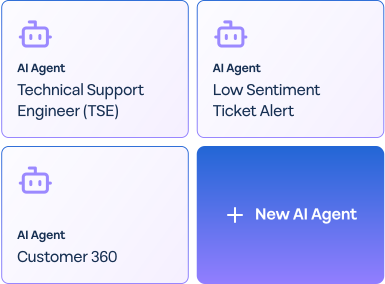
AI agents can be configured to handle routine support tasks such as:
- Ticket categorization for automated routing and analytics
- Ticket summarization to accelerate manual reviews and improve handoffs when needed
- Generating response drafts to boost agent efficiency during resolution
- Creating bug reports in Jira from support tickets wit with one-click
That’s only a small sample. Point is, while B2B customer service teams all face similar challenges, the way each one operates is unique. To get the most value from AI, B2B support teams need to be able to easily build agentic workflows that make their whole team more efficient.
7. VoC analytics to drive improvement
For B2B support teams, tracking surface-level ticket and tag volume isn’t enough. VoC analytics helps you uncover underlying themes and patterns across all support interactions—even for less frequent and specific issues.
With those insights, you gain deep visibility into product sentiment, feature gaps, and usability friction by analyzing conversational data at scale. This deep analysis—including your unstructured data—helps B2B teams monitor emerging pain points over time, spot recurring issues, and identify moments where proactive action is needed, long before those problems snowball into customer churn.
By turning support conversations into actionable insights this way, teams can bring real-world customer feedback supported by hard data into product and engineering discussions. If you’re tired of walking out of Engineering meetings feeling frustrated and ignored, this kind of deep voice of the customer analysis may be just the thing you need to finally get heard.
More importantly, it’ll help you ensure internal priorities align with actual customer needs—not the best guess and gut assumptions about what your customers value or prioritize.
8. Security and compliance that your CISO will approve
AI can transform the B2B customer experience, but none of it matters if your security team can’t sign off. For B2B companies—especially those serving regulated or large enterprise clients—data privacy and compliance are the gatekeepers to any new vendor.
When evaluating AI tools, make sure they meet the industry standards your customers expect: SOC 2 Type II, ISO 27001, and full GDPR compliance should be a minimum. You should also have clear, granular controls over what data the system can access, how it’s stored, and what information is visible to your team. And of course, no data should ever be shared with third parties or used to train external models.
Some vendors take this a step further. At Mosaic, for example, the whole platform was built with a security-first architecture designed specifically for enterprise environments. The platform meets all industry-leading standards, and it’s designed from the ground up to exceed modern security, privacy, and compliance requirements.

Stop wrestling with tools that weren’t built for B2B support
B2B customer service is growing more complex than ever. With multiple products, systems, and touchpoints in play, the old way of chasing issues across disconnected tools just doesn’t cut it anymore.
While B2C support platforms may make big promises, the reality is they’re just not suited for B2B support teams. The bottom line is that their architecture, priorities, and features don’t fit.
Modern B2B support teams need more. They need technology that can bring your customer data, internal knowledge, and team insights together in one AI platform, so that they can spend less time reacting and more time staying ahead of issues before they escalate.