




















Key takeaways
Most support leaders I speak with know their AI tools are working. They can feel it in the ticket queues. What they struggle with is putting a number on it, one that holds up in a budget meeting or a board review.
That's the core challenge with AI ROI measurement: not the math, but the framing. And it's why so many AI investments stall at renewal time, not because they failed, but because no one built a measurement system before deployment that could prove they succeeded.
This post covers the metrics that matter, how to structure a measurement framework built for B2B support specifically, and how to build the kind of ROI reporting that actually lands with executives, so the efficiency gains you can feel in the queue become value you can defend on a slide. Measurement is the unglamorous part of AI work, but it's what gets the next phase funded.
What is AI ROI, and why is it different in B2B support?
Quick answer: AI ROI is the measurable business value generated by an AI investment, expressed relative to its cost.
Put simply, AI ROI measurement is how you prove that the value attributable to AI outweighs what you paid for it, and the AI ROI metrics that matter most are the ones tied to support outcomes, not vanity usage stats. To measure the ROI of AI in B2B support, you need a clean read on a handful of those outcomes before and after you go live, so you can measure the impact of AI rather than guess at it.
The reason generic AI ROI frameworks break down in B2B support is that B2B tickets are not like B2C tickets. They are higher complexity, higher stakes, and often involve multiple internal stakeholders, layered product knowledge, and long resolution chains. A deflection rate that looks great in a B2C context, simple FAQ resolution, can mask poor outcomes in B2B, where the customer was deflected but the issue went unresolved, and an escalation follows two days later.
Measuring AI ROI in B2B support requires metrics calibrated to that complexity, not borrowed from consumer support playbooks.
How to calculate the ROI of AI
Before you can report on AI ROI, you need to know how to calculate it. The standard formula is straightforward:
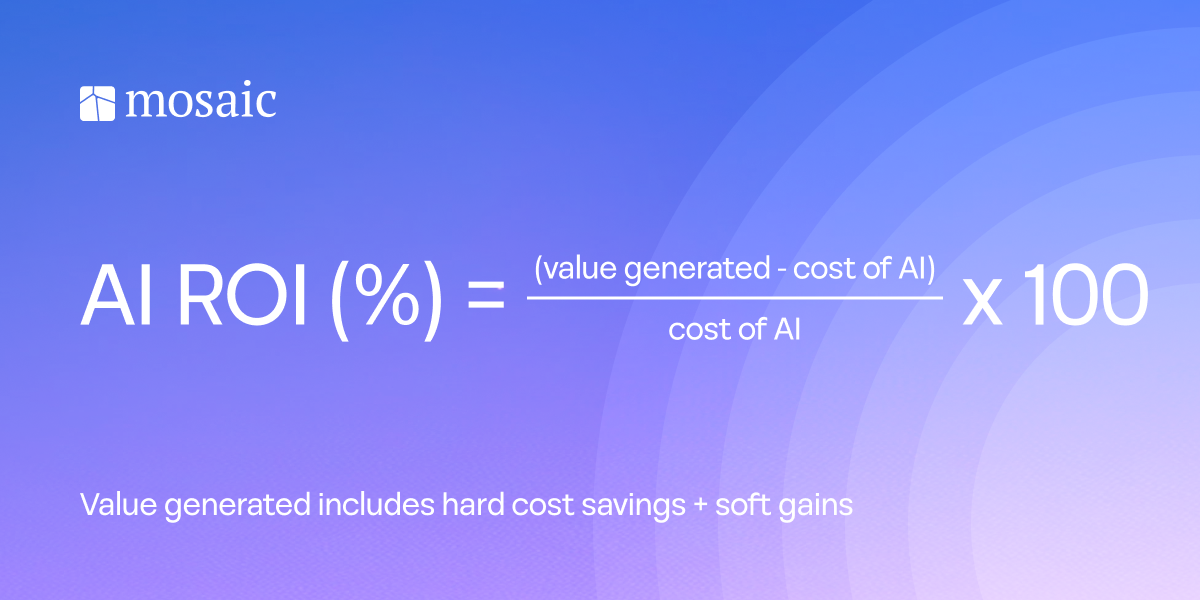
Where "value generated" includes hard cost savings (reduced headcount need, lower cost per ticket, broader cost reduction across the support org) plus soft gains (faster resolutions, higher CSAT, lower agent attrition).
You calculate AI ROI using two inputs: the value the system creates and what it costs to run. Get both right, and you have a comprehensive ROI picture; get either wrong, and the number falls apart under scrutiny. The key ROI drivers in B2B support are MTTR, cost per ticket, and deflection rate, and effective AI ROI measurement starts by isolating each one. The output is a single measurable value you can put in front of a CFO.
Why measuring AI ROI is harder than it looks
Understanding the definition is easy. Building a measurement system that holds up under scrutiny is harder for three structural reasons.
The attribution problem
AI rarely operates in isolation. When MTTR drops by 20%, was it the AI agent, the updated knowledge base, the recent product fix, or the support manager who reorganized the queue? Attribution is genuinely hard in complex support environments where multiple AI systems and process changes overlap, which makes clean decision-making about what's actually working difficult. Most teams do not set up the control conditions upfront to answer it cleanly.
The lag between deployment and value
AI value tends to compound slowly. The first 30 days are often net negative: agents are adjusting, the model is calibrating, workflows are shifting, and change management is still underway. ROI measured at 30 days looks very different from ROI at 90 or 180 days. Teams that report too early conclude their AI is not working. Teams that wait too long lose executive patience. The measurement window matters enormously.
The baseline problem
You cannot measure improvement without a reliable baseline. Most teams deploy AI under pressure and capture the baseline as an afterthought, or reconstruct it from imperfect historical data. Without a clean baseline for MTTR, cost per ticket, deflection rate, and escalation rate, your ROI number is an estimate at best. At worst, it's fiction.
"What teams were finding was one of two things: either the tech wasn't ready for them to actually meet their goals, or they had no way to track the value of these programs and think about what actual value would look like for their business." — Josh Solomon GM & VP of Revenue, Mosaic AI
Find out if your org is ready to properly adopt AI. Get your free AI Governance Checklist here.
Hard ROI vs. soft ROI: what's the difference?
Both count. Neither is sufficient alone. Understanding the distinction between hard ROI and soft ROI is the first step toward building a measurement approach executives will trust.
The strongest AI ROI cases combine both. Hard ROI justifies the spend. Soft ROI tells the story of what the organization becomes at scale. Together, they give business leaders a complete picture of the value realization curve and the confidence to keep investing.
The five key metrics to measure AI ROI in B2B support
Generic AI ROI frameworks list ten to fifteen metrics. In practice, B2B support leaders need to own five deeply, with clean baselines and consistent measurement, rather than track fifteen loosely. These are the metrics to measure AI ROI in support without drowning in dashboards.
A note on deflection rate: a high number is not automatically a good sign. If customers are deflected but their issue is not resolved, your escalation rate will tell you. Always read deflection and escalation together. This is especially true as you scale AI use cases beyond first-line deflection into more complex resolution workflows. As AI capabilities expand and AI systems take on harder tickets, the metrics that signal success shift with AI maturity.
How Mosaic AI helps measure AI ROI
Mosaic AI surfaces all five of these metrics in a unified view, pulling from your existing stack: Zendesk, Salesforce, Jira, and others, rather than requiring you to stitch data together manually. Unlike point AI solutions that report on themselves in isolation, that means your baseline and your ongoing measurement live in the same system, your ROI calculation is grounded in actual case data, not a spreadsheet reconciliation, and AI impact shows up as business outcomes rather than usage stats.
How to build an AI ROI measurement framework
A framework is not a dashboard. It is a set of decisions made before AI deployment that determine how you will measure, attribute, and report AI value over time. A successful AI program treats measurement as part of implementing AI from day one. Most teams skip this step entirely, building the measurement infrastructure after the fact, when the pressure to show expected ROI is already at its peak.
Set your baseline before you deploy
Before AI implementation goes live, capture your current MTTR, cost per ticket, deflection rate, escalation rate, and agent productivity. Pull 90 days of data, not 30. One-month snapshots are too easily distorted by seasonality or a single incident spike. Committing to low-friction AI onboarding means this step does not have to take long, but it cannot be skipped.
Define hard and soft metrics upfront
Decide before deployment which metrics constitute success and which are directional signals. If your executive team will only accept hard ROI, design your measurement around cost per ticket and headcount avoidance. If they are open to soft ROI, add CSAT and MTTR trend. The mistake is treating all metrics as equal and then scrambling to find a winning number after the fact. A clear AI strategy defines success criteria before deployment, not in response to a budget challenge six months later.
Choose your measurement window
Ninety days is the minimum for meaningful AI ROI data in B2B support. Six months is better. Set expectations with your executive sponsor at kickoff: directional signals at 30 days, preliminary ROI at 90 days, and a complete picture at 180. This protects you from the early-dip problem and keeps stakeholders engaged across the full realization curve. Teams that rush to report early ROI almost always understate actual ROI and lose credibility in the process.
Tie metrics to business outcomes, not AI activity
"The AI handled 4,200 tickets this month" is an activity metric. It tells you the AI was used. It does not tell you what it was worth, or whether the AI works. Every metric in your framework should connect to a business outcome: cost avoided, time reclaimed, customer retained, escalation prevented. This is especially important as AI adoption deepens and you begin scaling AI use cases across the organization. Measurement complexity grows with the footprint, and ROI reporting becomes a core part of your AI initiative governance.
Build a reporting cadence for executives
Monthly for operators, quarterly for executives. The quarterly executive summary should cover three things: the hard ROI number (cost avoided or cost per ticket reduction), the soft ROI trend (MTTR, CSAT, escalation rate), and the forward projection (what does this look like in 12 months if the trend holds). Two pages maximum. No raw data. It gives leadership the context for decision-making and keeps every stakeholder aligned. Think of it as an ROI assessment, not a metrics report. The job is to tell the story of business impact, not to display AI usage data.
Connecting support AI ROI to your broader AI strategy
Support is rarely the only place a company is investing in AI. As generative AI, agentic AI, and other enterprise AI technologies spread across teams, leaders increasingly want one view of value across all AI initiatives, not a separate scorecard for each tool. Support is often the first visible win in a larger AI transformation.
That's where support becomes a useful proving ground. The same discipline you apply here, clean baselines, hard and soft ROI, a defined measurement window, scales to your wider AI portfolio. It turns a collection of AI solutions into a measurable AI program, and it gives you a credible read on transformation ROI when the board asks what all this AI is actually worth. The teams that use AI tools well are the ones that measure them well, too.
The risk is letting support AI sit outside that picture. When you can show the AI impact of support alongside the rest of the AI business case, you strengthen the argument for continued investment and give an honest read on the ROI of your AI spend. Teams that get this right don't just improve AI performance in support; they build an AI strategy the whole company can measure.
What good AI ROI reporting looks like for executives
The most common mistake I see is presenting a metrics dump and calling it ROI reporting. Executives do not want to interpret data. They want a verdict with supporting evidence.
Good executive AI ROI reporting answers three questions in order: Did it pay back? Is it trending in the right direction? What does continued investment in AI unlock? The teams that answer these questions clearly are the ones that get budget approved for the next phase of their AI roadmap.
Mosaic's Intelligence product is built for exactly this. It translates raw support data into business-level outcomes, so the report you bring to your CFO is drawn from the same system your agents use every day, not a separate analytics exercise bolted on at quarter end.
Book a demo to see Mosaic AI in action.
Common mistakes that skew your AI ROI numbers
Even well-designed measurement frameworks run into these consistently:
- Measuring deflection without resolution. High deflection paired with high escalation is not ROI: it is friction redistribution. Always pair them.
- Ignoring the cost of implementation. Agent training time, workflow reconfiguration, and IT lift belong in the cost side of your ROI equation. Many teams exclude them and then cannot explain why the realized ROI is lower than projected. This is one of the most common reasons AI projects appear to underdeliver on their expected ROI.
- Using the wrong measurement window. Thirty-day reads on a B2B support AI deployment are almost always misleading. The value curve in B2B is slower than in B2C. Plan for it.
- Forgetting soft ROI on the cost side. Agent attrition is expensive. If your AI is reducing burnout and keeping agents longer, the avoided recruitment and onboarding costs are real and belong in your ROI case.
- Not separating AI ROI from other changes. If you rolled out a new knowledge base and a new AI agent simultaneously, your ROI number is a blend. Isolate variables where you can, and be transparent about attribution where you cannot. This is a particular risk in organizations early in their AI adoption journey, where multiple AI initiatives may be running at the same time.
FAQs
What metrics should I use to calculate AI ROI in customer support?
Start with five: ticket deflection rate, MTTR, cost per ticket, escalation rate, and agent productivity. These give you both the hard cost picture and the leading indicators that signal whether the efficiency is real or just surface-level. High deflection paired with rising escalations, for instance, signals the AI is deflecting without resolving, a net negative.
How long does it take to see measurable ROI from an AI deployment?
In B2B support, plan for 90 days before drawing conclusions and 180 days for a complete ROI picture. The first 30 days typically involve workflow adjustment and model calibration; reading ROI at that point almost always understates value. Set that expectation with your executive sponsor at kickoff.
How do I prove AI ROI to executives and the board?
Answer three questions in order: Did it pay back? Is it trending in the right direction? What does continued investment unlock? Lead with the hard cost number, support it with the soft trend, and close with the forward projection. Keep the executive summary to two pages. Raw metrics belong in an appendix, not on slide one.
Why do so many AI ROI calculations come up short?
Three reasons dominate: no baseline was set before deployment, the measurement window was too short, and soft ROI was excluded from the business case. According to the BCG Build for the Future 2025 Global Study (n=1,250), 60% of organizations generate little or no material value from AI despite significant investment, not because the AI failed, but because the measurement and value realization infrastructure was never built. For many, the gap between expected ROI and actual ROI comes down to one thing: they treated measurement as an afterthought rather than a foundation.
What's a realistic deflection rate for B2B support AI?
For early-stage deployments, 20–30% is a reasonable target. Teams with a mature, well-structured knowledge base and broader AI use case coverage can reach 40% or higher. In B2B specifically, always read deflection rate alongside escalation rate, high deflection paired with rising escalations signals the AI is deflecting without resolving.
Should I measure ROI per AI use case or across the whole program?
Both, at different stages. Early in your deployment, measure per use case, which tells you which applications are generating value and which need refinement. As you build confidence and scale AI use cases, a program-level view becomes more useful for executive reporting. The risk of program-only measurement is that poor-performing use cases hide behind strong ones.
How do I set a baseline for AI ROI before deployment?
Pull 90 days of pre-deployment data for your five core metrics: MTTR, cost per ticket, deflection rate, escalation rate, and agent productivity. Avoid single-month snapshots, they are too easily skewed by seasonal spikes or one-off incidents. Store the baseline in the same system you will use for post-deployment measurement so the comparison is apples-to-apples.