Key takeaways
- Scaling B2B customer support isn't about hiring more agents—it's about multiplying the impact of the team you already have.
- The biggest barriers to scaling support are fragmented customer data, stale knowledge, and over-reliance on engineering to build automation.
- AI-native platforms help support teams automate repetitive work, surface real-time customer context, and catch issues before customers ever report them.
- Proactive support means identifying risks and intervening before escalation and is only achievable at scale with the right platform.
- Teams using Mosaic AI have cut ticket handling time by up to 30%, deflected nearly half of all Tier 1 tickets monthly, and improved CSAT scores from 79 to 93.
- The path to scaled support starts with one defined use case, a clear ROI target, and a platform that connects your entire tech stack.
For most of the last two decades, the default answer to scaling customer service was simple: hire more people.
That playbook is broken. And in B2B support, it was never a great fit to begin with.
B2B support isn't the same problem as B2C support. When you're supporting enterprise customers, you're dealing with six-figure contracts, multiple stakeholders per account, complex product implementations, and SLA commitments that carry real legal and commercial consequences. A single churned enterprise customer can wipe out the revenue equivalent of a hundred consumer cancellations. Instead of answering simple questions, your agents are spending time managing relationships, troubleshooting integrations, and navigating internal escalations across engineering, product, and customer success.
Most content about scaling customer support ignores all of that. It's written for e-commerce teams fielding "where's my order" tickets, not for support leaders managing the complexity of enterprise B2B SaaS.
This guide is different. It covers what it actually takes to scale customer support in a B2B environment: the real barriers, what the strategies look like in practice, and how the best enterprise support teams are scaling their impact without scaling their headcount or costs.
What does it mean to scale customer support?
Scaling customer support means increasing your team's capacity to resolve customer inquiries, prevent issues, and deliver great customer experiences—without proportionally increasing headcount or cost.
In B2B, this distinction carries real weight. You're not just handling more tickets. You're managing complex implementations, high-value relationships, multiple stakeholders per account, and SLA obligations that carry commercial consequences.
Scaling your customer support team's impact means more customers get better, faster service from the same number of agents. It means your support operations become more predictive than reactive. And it means your support data starts informing decisions across product, customer success, and revenue—not just helping agents close tickets faster.
The pressure to do this is real and felt widely. Among enterprise companies already using AI to address labor and skills pressures, 47% are doing so by automating customer self-service answers and actions, according to IBM, making it one of the most common AI applications in support today. The gap between those teams and the ones still relying on headcount is widening fast. The teams pulling ahead aren't just working harder. They're building smarter infrastructure around unified data, AI-powered tooling, and proactive support practices.
Why scaling B2B customer support is harder than it looks
If you're a support leader, you already know why this is hard. But it's worth naming the specific barriers, because they're what any effective strategy has to actually solve.
Hiring is slow, expensive, and doesn't compound
Onboarding a B2B support agent can take three to six months before they're genuinely productive. SMEs who deeply understand your product become bottlenecks, and when they leave, institutional knowledge walks out with them. Every new hire resets the clock on building real expertise.
Knowledge goes stale faster than teams can keep up
Tribal knowledge lives in Slack threads. Your knowledge base lags behind a product that ships constant updates. Keeping content accurate without dedicated technical writers costs hundreds of thousands in annual headcount. When knowledge is stale, agents waste time, customers get inconsistent answers, and self-service stops working.
Automation requires engineering (and engineering has other priorities)
Building or updating automated workflows in most B2B environments requires a ticket to engineering. Support teams need to move fast and adjust on the fly. Engineering dependencies make that nearly impossible, which is part of why average handle time (AHT) stays stubbornly high in many organizations. Support-related development work almost always sits at the bottom of the product roadmap.
Disconnected customer data fragments the picture
Billing lives in one system. Product usage logs are in another. CRM data is somewhere else. Ticket history is in your support platform. When a customer reaches out, agents spend minutes hunting across tools just to understand who they're talking to. That's a direct tax on every single interaction, and it compounds across hundreds of tickets a week.
Product complexity keeps raising the bar
B2B products have deep feature sets, custom configurations, and complex integration dependencies. Many support platforms weren't built for this. They were designed for B2C or SMB use cases and struggle with enterprise B2B demands, forcing teams to work around their own tools.
Leaders can't see what's breaking until it's already broken
When data is fragmented and visibility is limited, support leaders operate blind. They can't identify which issues are trending, which customers are at risk, or where their team's time actually goes. Proving ROI becomes guesswork. Proactive improvement becomes nearly impossible.
How to successfully scale your customer support without adding headcount
The strategies below are what high-performing B2B support teams are doing right now to scale their impact without scaling their costs.
1. Cut ticket volume before it reaches agents
Every ticket your system resolves automatically is one less ticket a human agent handles. That's the math behind tier-1 ticket deflection. And in B2B support, it adds up fast.
The key is self-service that actually works. Not a static FAQ page. Not a keyword search that returns irrelevant results. An AI-powered experience that understands customer context, pulls from accurate and current knowledge, and resolves the issue without requiring an agent.
When a customer searches "integration setup," a good self-service system knows their account, their existing integrations, and surfaces the exact guidance they need. That's the difference between deflection that works and deflection that just frustrates your customers.
To make this work, you need a tool that continuously identifies content gaps, drafts new knowledge articles for human review, and keeps your help center current with your product. Done right, reducing ticket volume through intelligent self-service also improves customer satisfaction—customers get answers faster, on their own terms, without waiting in a queue.
Proactive self-service such as guided onboarding flows, in-app tooltips, and targeted outreach based on usage patterns, prevents tickets from being created in the first place. The best B2B support teams think about self-service as prevention, not just deflection.
2. Make every agent perform like your best agent
This is one of the highest-impact ways to scale customer support: close the performance gap between your top agents and the rest of the team.
Agent assist tools make this possible. Think of them as a personal AI assistant embedded in every agent's workflow that surfaces relevant customer context, suggesting responses, summarizing ticket history, and flagging knowledge gaps in real time. When integrated with your entire tech stack, they give every rep access to the same depth of customer knowledge your best agents have built through years of experience.
The impact is immediate. New agents ramp faster. Tenured agents spend less time searching and more time solving. The entire team delivers more consistent, higher-quality support across every customer interaction.
There's a detailed breakdown of what this looks like in practice in our guide on how to improve agent productivity in B2B support, including the specific workflows and the metrics that shift fastest.
3. Shift from reactive to proactive
Reactive support has a ceiling. You can get faster at responding to problems, but you can't outrun volume growth through speed alone. The teams genuinely scaling their impact have made the shift from reacting to preventing.
AI makes this possible at scale. It can analyze product usage, ticket patterns, and customer behavior simultaneously, and automatically surface signals that predict escalation, churn risk, or emerging issues. A customer who opens twice their usual ticket volume in a week. A cohort showing declining usage after a recent product update. A segment where sentiment is trending negative before anyone has complained.
These signals exist in your data right now. Most teams just don't have the infrastructure to see them.
Customer experience automation is what turns these signals into action, routing alerts to the right person, triggering proactive outreach, or surfacing an issue for a CSM before it becomes an escalation. When support teams operate proactively, customer retention improves, escalations decrease, and support's strategic value becomes much easier to demonstrate to leadership.
4. Automate internal workflows without engineering
Support reps don't just work tickets. They file bug reports, submit feature requests, pull CRM data, update records, and ping colleagues for context. This non-ticket work is a real drag on capacity, and most of it is automatable without writing a single line of code.
No-code AI agents let support operations teams build and deploy automations without waiting on engineering. A workflow that creates a Jira ticket from a resolved support case. An automation that enriches every incoming ticket with relevant account data. A trigger that routes high-priority accounts to senior agents based on contract value.
Our guide to using an AI workflow builder for support teams covers how to set these up, including the use cases that deliver the fastest ROI for B2B support operations.
The impact isn't just time saved. It's consistency. When the right customer data is automatically attached to every ticket, agents start with better context. When bugs are logged automatically, engineering gets cleaner signals. When escalation rules are automated, high-risk accounts get handled faster.
This is what AI support automation looks like when it's applied to the full scope of support operations—not just the customer-facing interactions.
5. Give leaders the visibility to improve continuously
Support leaders are often the last to know what's actually happening in their operation. They're managing the queue, handling escalations, sitting in meetings. All while the data that would tell them where to focus stays locked in tools they don't have time to dig into.
AI changes this by making analysis continuous and automatic. First response time, first contact resolution, CSAT, deflection rates, escalation patterns—all of it surfaces in real time, without someone having to build a manual report.
More importantly, AI can connect the dots between metrics in ways human analysis can't. It can tell you not just that your AHT increased, but why, and specifically which ticket categories or agent cohorts are driving it. That's the kind of visibility that lets support leaders make proactive decisions: where to invest in training, which knowledge gaps to close, which customers need attention before they get worse.
"The leaders who scale their teams' impact fastest aren't the ones who work harder—they're the ones who finally have the data to work smarter. AI gives support the same analytical leverage that sales and marketing have had for years." — Alon Talmor, CEO, Mosaic AI
6. Turn support into a revenue protection engine
Every other strategy in this list improves efficiency. This one protects revenue—and in B2B, that's where the real business case for scaled support lives.
Churn doesn't announce itself. Customers rarely send a strongly-worded complaint before they cancel. They disengage quietly. Usage drops, tickets spike, sentiment shifts are the lagging indicators until the day the renewal conversation goes badly. By the time it surfaces in a QBR, the decision has often already been made.
Here's the good news: The signals that predict churn are sitting in your support data right now. Most teams just don't have the infrastructure to see them in time to act. Here's what they look like in practice:
- Volume spikes. A customer who normally opens two tickets a week starts opening eight. That's not a coincidence; it's friction. Agents working individual tickets will never see the pattern. A unified platform flags it automatically.
- Sentiment shifts. The language in a customer's tickets changes. They go from asking questions to expressing frustration. Generative AI can track this across your entire customer base simultaneously, not just the accounts you happen to be watching.
- Usage drops. A customer stops using features they were previously active on. When product usage data is connected to your support platform, this signal becomes visible. Without that connection, it's invisible until the CSM asks on a quarterly call.
- Escalation concentration. One account generates a disproportionate share of your escalations over a 30-day window. That's the sign of a customer who isn't getting what they need.
In B2B support, enterprise ACV typically exceeds $100,000 per customer annually, and for complex SaaS products with deep implementations, significantly more, according to SaaS Capital's 2025 survey of more than 1,000 private B2B SaaS companies. Preventing one churn that would otherwise have been missed can justify an entire AI platform investment on its own.
When Customer Success teams have access to unified support data, they can stop relying on quarterly check-ins to discover problems. The support function becomes an early warning system that routes risk alerts to the right person before the customer considers alternatives.
That's when support stops being a cost center and becomes a genuine revenue driver. It's also the argument that gets the CCO and CFO to fund the platform investment in the first place.
Why disconnected tools make scaling impossible
Most B2B support stacks include lots of expensive tools that don't actually talk to each other.
They all have integrations. But those integrations are surface-level. The customer data that lives across your CRM, ticketing platform, product analytics, knowledge base, and internal communication tools never comes together in a way that's useful to an agent working a ticket in real time.
The consequences compound:
- Your AI features can only be as good as the data feeding them. If that data is fragmented or stale, AI recommendations are wrong (even confidently so) and that erodes agent trust fast.
- Agents who can't get a unified view of a customer spend their time switching between tools instead of solving problems. That's a direct hit to first response time, resolution speed, and customer satisfaction.
- Leaders who can't see across systems can't identify trends, can't prioritize improvements, and struggle to prove ROI.
Automating B2B support tickets doesn't work when the automation is pulling from incomplete or inconsistent data. Automated ticket resolution fails when the knowledge base driving the AI is out of date. Every AI initiative built on a disconnected stack is building on sand.
The only sustainable path to scaling customer support without adding headcount is a platform that unifies your data, knowledge, and workflows into a single intelligence layer, and keeps it all current automatically.
How Mosaic AI helps B2B support teams scale
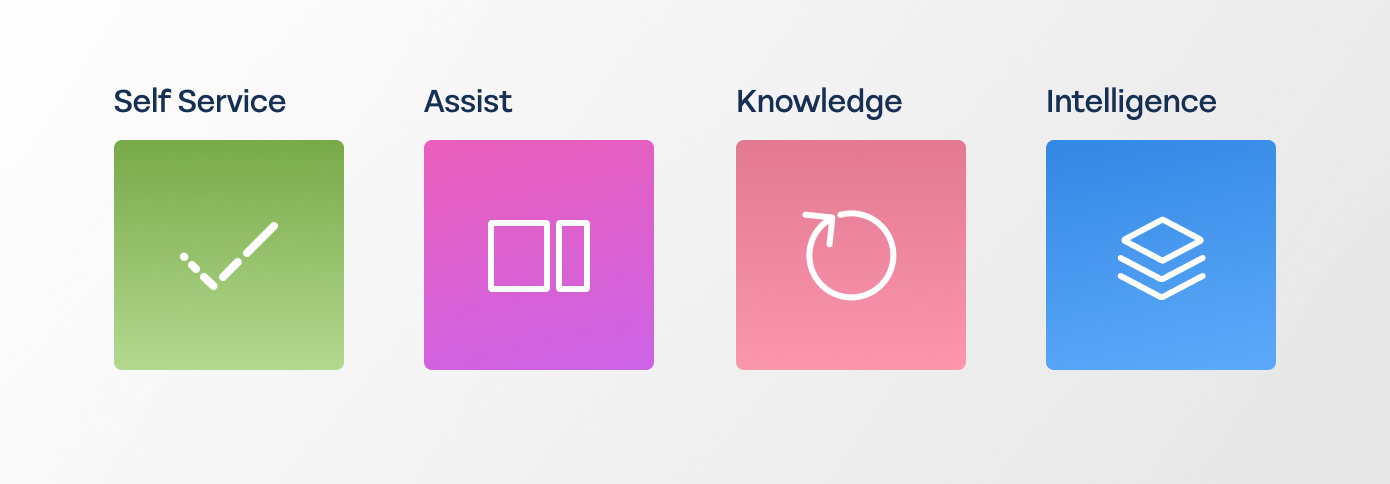
Mosaic is an AI-native platform built specifically for B2B support. It connects your data, knowledge, and workflows so your team can move from reacting to issues to preventing them, and scale their impact without scaling headcount. Mosaic AI's suite of products include:
- Self Service deflects customer inquiries before they reach agents. It's so much more than a static chatbot—it's a context-aware AI experience that pulls from accurate, current knowledge and understands each customer's account history. The result is fewer tickets, faster answers, and better customer experience for routine interactions.
- Assist gives every agent real-time access to the context, knowledge, and guidance they need to resolve tickets confidently. It pulls from your entire tech stack—CRM, ticketing, docs, Slack, and more—and surfaces relevant information without requiring agents to search for it. Every rep gets the full picture, every time.
- Knowledge keeps your knowledge base accurate and current automatically. It identifies gaps based on incoming tickets, drafts new articles for human review, and flags outdated content before it creates problems. Your team stops chasing documentation and starts spending time where it matters.
- Intelligence monitors your entire customer base for risk signals, emerging product issues, and sentiment trends. It routes alerts to the right people so your organization can act before customers escalate or churn.
All of it is connected through a unified customer data layer that processes and enriches information from every source in your tech stack. This means the AI always works from clean, accurate, complete data.
And for teams that want to build custom automations, Mosaic's no-code Agent Builder lets support operations teams deploy and modify workflows without engineering support. If you're looking for a place to start, our guide to support automation quick wins covers the use cases that deliver the fastest results for B2B teams.
Curious if you're in a good spot to go-live with an AI-native platform? Check out this interactive checklist that includes all key components confident AI adopters check before they go live.
Real results: what scaling support impact looks like
Cynet: faster resolution, fewer escalations, stronger CSAT
After deploying Mosaic, Cynet deflected approximately 47% of Tier 1 tickets monthly, nearly half of all routine customer inquiries resolved without a human agent. Ticket resolution times dropped by nearly 50%. CSAT improved from 79 to 93. With fewer repetitive tickets pulling SMEs into escalations, the support team recaptured approximately 25 hours per week to focus on higher-value work.
Yotpo: 30% faster handling, fewer internal tickets
Yotpo agents using Mosaic on a daily basis achieved a 30.2% reduction in ticket handling time. The knowledge team used Mosaic's gap identification to build targeted documentation instead of guessing what customers needed—replacing reactive content creation with a data-driven process. Internal support tickets also dropped meaningfully as agents stopped relying on SME interruptions to find answers.
"The ability to search across all our data sources is just simply incredible. It saves our team so much time that we used to spend trying to find the relevant answer, and if the answer doesn't exist, it allows us to identify the knowledge gaps." — Gil Fiarberger, VP Delivery, Yotpo
Monday.com: consistent improvement across the team
Among monday.com support agents actively using Mosaic AI, ticket handling time dropped by 13.5% (compared to just 1.4% for agents not using it.) Agents credited Mosaic's ability to search across multiple sources (Guru, Slack, internal docs) and return accurate answers as one of the biggest day-to-day improvements. Customers got faster, more consistent answers. Agents spent far less time digging through scattered systems.
How to start scaling your B2B support operation: 4 simple steps
Scaling customer support doesn't require a big-bang transformation. The teams that succeed start small, prove ROI quickly, and expand from there. Here are four simple steps to get started in the right direction.
1: Assess your current capacity and gaps
Start by identifying where the friction actually lives. Where does ticket volume spike? Where do escalations get stuck? Where are agents the slowest? Which customers keep coming back with the same problems?
These questions point to your highest-impact starting points and help you build a business case with specific, defensible numbers, as opposed to rough estimates.
2: Pick one use case and prove it
Don't try to solve everything at once. Choose the use case with the clearest path to measurable ROI. Whether that's deflecting Tier 1 tickets, improving agent context, or automating a specific internal workflow. Run it. Measure it. Show the numbers.
A single proof point with real data does more to build organizational buy-in for AI than any amount of roadmap planning.
3: Roll out and refine
Once you've validated the first use case, expand it to the full team. Then move to the next item on your list. Each expansion gives you more data, more credibility with leadership, and a clearer picture of where to focus next.
4: Consolidate and compound
Over time, a unified AI platform replaces point solutions that were doing individual jobs in isolation. As your tech stack simplifies, data becomes more consistent, AI becomes more accurate, and the ROI compounds. Teams that reach this stage find their support operation becomes genuinely self-improving, becoming more efficient with every customer interaction.
FAQs
How do you scale customer support without sacrificing quality?
The key is giving agents better tools and context, not just faster workflows. When every agent has access to accurate knowledge, real-time customer context, and AI-assisted guidance, quality improves alongside efficiency. Automating repetitive work frees agents to spend more time on complex, high-value interactions where quality matters most.
What are the biggest barriers to scaling B2B customer support?
The most common barriers are fragmented customer data across disconnected tools, stale knowledge bases, engineering dependencies for building automation, and limited visibility into support trends and customer risk signals.
How does AI help support teams scale?
AI helps support teams scale by automating Tier 1 resolution, surfacing customer context for agents in real time, identifying knowledge gaps, predicting escalation risk, and giving leaders continuous visibility into team performance, without requiring manual analysis.
When should you scale your customer support team?
There are two ways to read this question—and they lead to very different answers.
If you mean headcount: most support teams scale their people too early, before they've exhausted what their existing team can do with better tools and processes. Genuine headcount scaling makes sense when SLAs are consistently breached despite high agent utilization, when your Tier 1 deflection rate is already strong and complex issues still can't keep up, or when you're entering a new market or product line with support needs that can't be automated.
If you mean impact: the answer is now. The teams that build the right infrastructure early—unified data, AI-powered agent tools, self-service that actually works—are the ones that avoid the reactive spiral altogether. Waiting until you're overwhelmed makes the transformation harder, not easier.
How long does it take to see results from AI support tools?
It depends on the platform and use case. Mosaic AI customers typically see measurable impact within 30 to 60 days when starting with a focused use case. Teams that define a clear success metric upfront—like deflection rate or AHT reduction—tend to see results fastest.